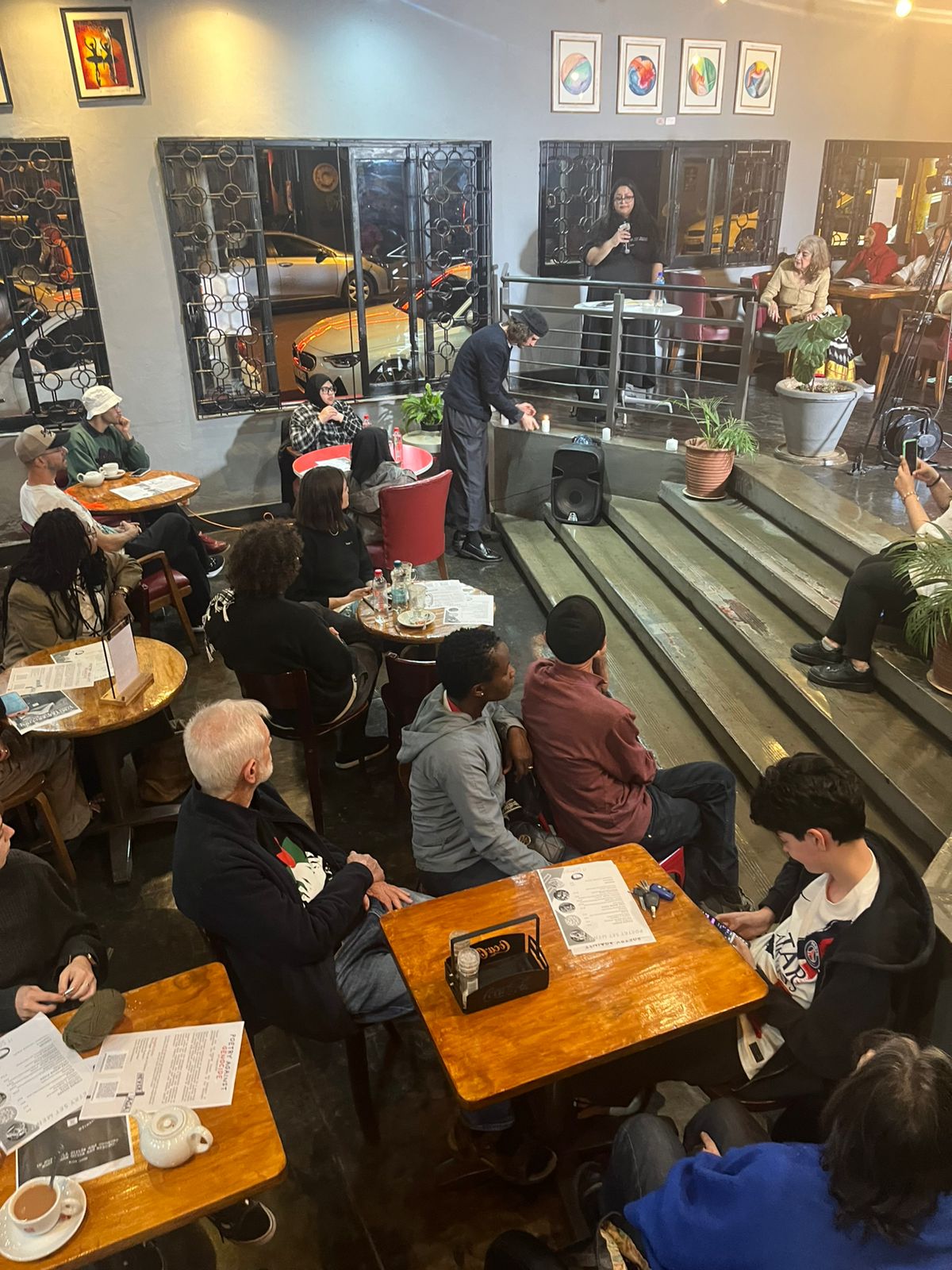
In Johannesburg, the 8th annual Rohingya genocide commemoration moved beyond one community’s pain and reached for something larger. This year, the initiative titled “Poetry Against Genocide” carried voices from Palestine, Sudan and Congo, while remembering the tragedies of Rwanda, Bosnia, Cambodia, and Namibia.
“As we are currently living through a time of perpetual genocide, we thought it would be wise to highlight as many of them as we have capacity to in order to raise awareness and foster solidarity,” said Fathima Zahra Ebrahim Mayet, a PhD candidate at the University of Johannesburg and a volunteer at Protect the Rohingya.
SMread: Abeer Zayyad: Defending Palestinian heritage
Why poetry still matters
As a trained historian, Mayet has always been drawn to the power of words to preserve memory. She explained that the Rohingya’s own traditions are largely oral, with poetry serving as a vessel for over 800 years to pass down stories of survival and faith.
“When the organisation decided they would like to do something different, I suggested we participate in something that has been part of Rohingya traditions for centuries,” she said. Poetry is not just art, it is history in motion.
For centuries, poetry has been a way to break silence, to resist oppression, and to speak when the world has tried to strip people of their voices. From Maya Angelou’s Still I Rise and Caged Bird to Langston Hughes’s I Look at the World, poets have used imagery and rhythm to call out injustice and to remind us of the unshakable strength of the human spirit.
This is why the organisers chose poetry as their weapon of choice. “It gives a voice to the marginalised and the voiceless thereby allowing us to foster empathy and engage in solidarity with other human beings,” explained Mayet. “It can inspire us to take action in situations of genocide and helps us to learn from the past.”
SMread: Zayat: Lebanese civilians killed by Israel after ceasefire
Carrying words into the future.
The campaign is not just about performance, it is about creating memory. By collecting poetry on lesser-known genocides, the organisers are building an archive that young people can turn to long after the events are over.
“For young people from the international community, I think it provides a safe space for them to express themselves and develop their artistic abilities,” Mayet noted. “For future generations that come from groups that have suffered genocide a part of our goal was to create an archive of poetry that relates to these lesser-known genocides.”
In this way, poetry becomes a bridge between generations. It tells the stories of those who came before and gives courage to those who come after. It shows that the struggles may be different, but the wounds are often carved from the same systems of power.
Poetry has long been tied to activism, with words carrying the power to shape thought, emotion, and action. What people read and listen to often influences how they perceive the world around them. As poet Warsan Shire wrote, “No one leaves home unless home is the mouth of a shark.” Such lines highlight that behind statistics and headlines lie human beings with untold stories. At its core, poetry serves as a medium that teaches society to listen and to feel.
The campaign “A Poem Against Genocide” is still open online, inviting people to submit poems via Instagram (@apoemagainstgenocide).
Every contribution becomes part of the growing chorus that refuses to forget, refuses to be silent, and refuses to let history bury the voices of the oppressed.
Images: Protect the Rohingya
