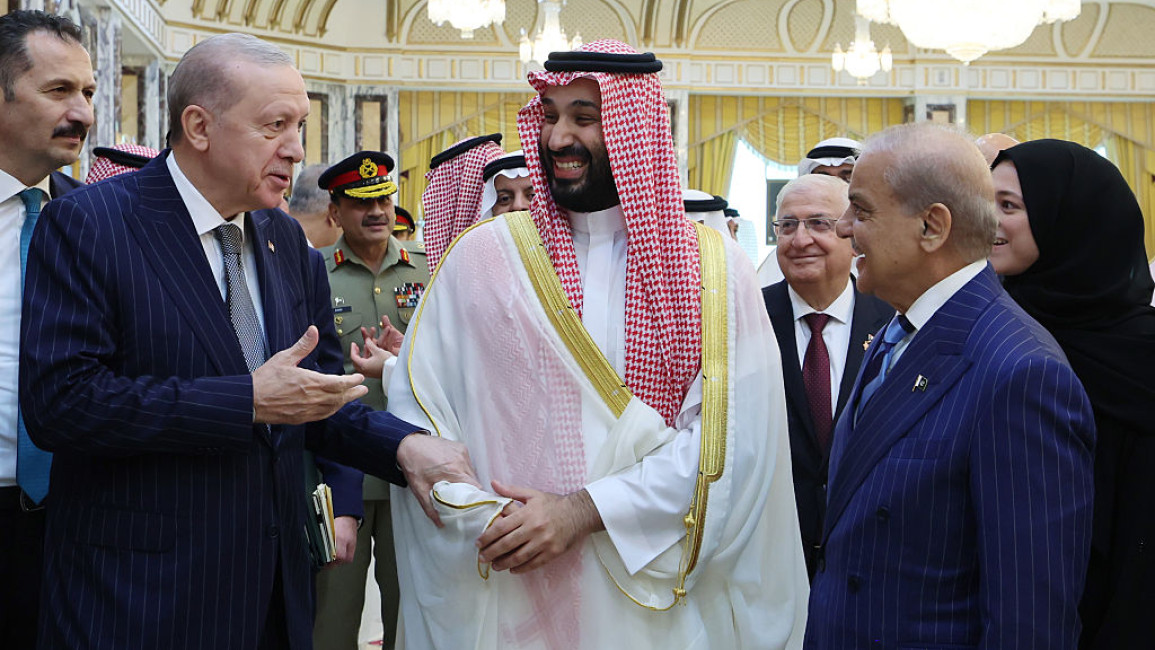
Image Source: The New Arab
World – Professor of Law, Religion and Global Politics, Professor Junaid S. Ahmad believes the Mecca Defence Pact between Saudi Arabia, Pakistan and Turkey has less to do with Muslim unity than with keeping the region’s rulers in power. He said the pact’s true purpose was becoming clearer as it was put into action.
Ahmad said the agreement, signed in Mecca in August, had been deliberately kept vague and presented as a NATO-style collective defence pact. He said it took on real meaning this week after Saudi Arabia invoked it amid the escalation in Yemen, with Turkish and Pakistani forces now being deployed.
“At the end of the day, this may be just about regime survival for the Saudis and all of these other regimes … So this is about regime preservation and survival, I think more so than some type of a project for a Muslim, Muslim advancement and social justice for the ummah,” he said.
A Shifting Security Order
For decades, Gulf states have relied on US military bases on their soil for protection. The US-Israeli war on Iran has raised fresh questions about how dependable that arrangement is. The Mecca pact is widely seen as the clearest sign yet that regional powers are looking to one another, rather than Washington, for their security.
Ahmad said the past year had seen the collapse of the security architecture that had existed in West Asia for about 70 years. He said US bases proved to be targets for Iranian missiles rather than protection, leaving Saudi Arabia doubting that Washington would come to its rescue regardless of how much money it spent.
“Whether it’s the Pakistanis, the Turks, the Gulf countries, they also know one thing that Iran is actually fighting their war for them. That if Iran fell now, Israel will be coming to these other countries,” Ahmad said.
Silence Over Gaza
The pact has also prompted comparisons with the response to Gaza, where tens of thousands of Palestinians have been killed by the Israelis over the past two years. Muslim-majority states did not mount a collective military response during that time.
Ahmad questioned why no comparable effort was mobilised for Gaza, calling it a reflection of the political and moral bankruptcy of wealthy Gulf regimes and heavily armed states such as Turkey and nuclear-armed Pakistan.
He said these states offered only statements and communiqués during the genocide, failing even to threaten a protective force, yet acted swiftly once Saudi territory was threatened.
“The main issue in the region is, of course, the understanding that this Zionist regime, Israel, is a rogue country. No one can restrain it, and I mean no one, and that means even Washington can’t constrain it,” he said.
Ahmad said many Muslims were disheartened that the pact’s first collective action was directed against the force that had tried hardest to stop the genocide in Gaza. He said it no longer made sense to view the alliance as a cause for the ummah.
