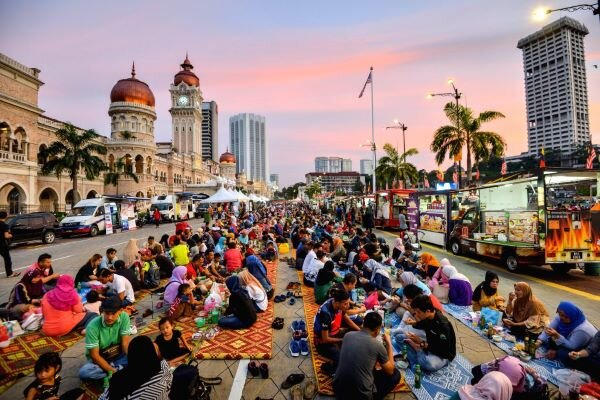
There is something deeply human about how Ramadan shows up in different parts of the world. In Malaysia, it is not present just inside homes or mosques. It spills into the streets, into food, into culture, into conversation.
Ramadan is not an individual experience in Malaysia. It is a community experience.
Mosques fill up night after night. Not just for tarawih, but for connection. People do not rush in and out. They stay. They eat together. They talk. They exist together in a way that feels like everyone belongs.
The last ten nights carry a different kind of energy. Streets in Kuala Lumpur and even smaller kampongs stay alive. Ramadan feels less like obligation and more like a sense of family.
SMread: Maximising the final ten nights of Ramadan
Where food becomes a language of care
If you want to understand Malaysian Ramadan, you look at the food. Not just what is eaten, but how it is shared.
Ramadan Bazar becomes a gathering point. It is not exclusive to Muslims. Everyone shows up. Different cultures, different backgrounds, all moving through the same space.
And then there are the dishes that carry history.
Bubur Lambuk is not just porridge. It is a memory. It is something that gets prepared in large quantities and given out freely at mosques. No transaction. Just giving.
Martabak (commonly known as murtabak) reflects Indian Muslim influence. A reminder that cultures do not sit separately here. They blend.
After long nights of prayer, mosques serve moreh, a light meal. It is simple, but it is comforting. When one shows up, they get to sit, eat, and rest. Food is not an indulgence, but a form of connection.
Identity that adapts without disappearing
Malaysia holds a deep lesson in cultural identity. Malay Muslims form the majority, but communities like Tamil Muslims are not erased. Instead, there is a kind of assimilation that feels easy.
You will see traditional Malay attire like Baju Melayu and Baju Kurung during Eid. But you will also see shalwar kameez. And sometimes, you will see both within the same family.
Even more interesting, non-Muslims participate too. Wearing traditional Malay outfits during Eid. Showing up. Being part of the moment.
SMread: Joburg’s rotten egg smell traced to Mpumalanga coal operations
Ramadan does not ignore the world outside
One of the most important parts of this conversation is how Ramadan is not disconnected from global reality.
Inside mosques, alongside prayers for personal needs, there are duas for people facing oppression. Palestinians. Sudanese. Others who are carrying hardship.
There is an understanding that fasting is not just about hunger. It is about awareness. And that awareness turns into action.
When faith moves into activism
Ramadan becomes a time where people start questioning their choices. What they buy. Who they support. Where their money goes.
There has been a noticeable shift in Malaysia. More people are engaging with ethical consumerism. Less resistance to difficult conversations around boycotts. But it is not simple.
There are political ties. Religious sensitivities. Economic realities. Some brands sit in grey areas, especially when linked to Muslim-majority ownership.
So the movement is not perfect. It is evolving. And maybe that is the point. Consciousness doesn’t start off as complete, it grows with time.
To forgive and forget
As Ramadan closes, Eid carries its own tradition. It is not just a celebration for most. It’s more. A time for families to gather. For people to forgive. For love to be shared.
There is a phrase exchanged that centres forgiveness. A way of saying: whatever sat heavy between us, we let it go.
And then there is Duit Raya. Small envelopes of money given to children and those who are unmarried. A tradition influenced by other cultures, yet fully embraced.
It reflects something deeper about Malaysia. Culture here is not timid, it is shared, it is flexible, it is beautiful.
What Malaysia gets right
There is a reason Malaysia often gets described as harmonious. Not because it is perfect. But because it chooses coexistence over control.
Different religions. Different ethnic groups. Different histories. Yet there is an effort to meet in the middle.
In many ways, it mirrors what South Africa calls itself. A Rainbow Nation. Not without its problems, but built on the idea that diversity does not have to divide.
And during Ramadan, that idea feels more real.
The takeaway is the intention
What stands out is not just the bazars, the food, or the clothing. It is the intention behind it all.
Ramadan in Malaysia shows what happens when faith is not kept private. When it moves into how people gather, give, speak, and even protest.
It becomes more than ritual. It becomes a way of being. And that is what Islam really is about.
If you’d like to hear more about the culture of Malaysia, watch the video below:
Image via Wahdah.
