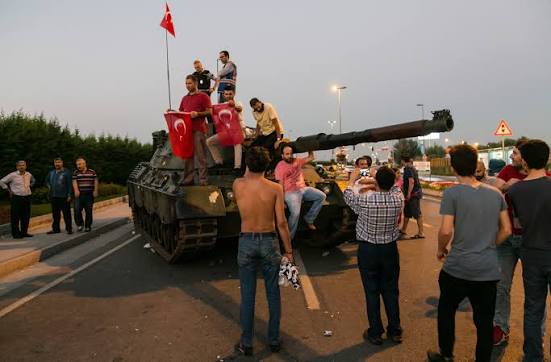
Türkiye is marking a decade since the failed coup attempt of 15 July 2016, when rogue elements within the country’s military tried to overthrow President Recep Tayyip Erdoğan’s government. The attempted takeover, which unfolded across Ankara and Istanbul, left more than 250 people dead and over 2,700 injured before it was brought under control.
Ten years later, the events of that night continue to shape the country’s politics, security policies and national identity, with Associate Professor in International Relations based in Istanbul, Prof. İbrahim Karataş, reflecting on how close Türkiye came to a different future.
The attempted coup remains one of the most defining moments in Türkiye’s recent history. Fighter jets bombed the Turkish Parliament while tanks rolled through the streets of Istanbul as sections of the military sought to seize control. Civilians confronted soldiers in an effort to resist the takeover, creating scenes that would become engraved into the country’s memory.
The Turkish government blamed the coup attempt on the Fethullah Terrorist Organisation (FETÖ), led by the late US-based cleric Fethullah Gülen. The movement has consistently denied involvement.
In the years that followed, authorities launched widespread dismissals and arrests affecting tens of thousands of soldiers, judges, academics and journalists. Supporters have said that the measures were necessary to eliminate a serious threat to the state, while critics argued they weakened democratic institutions, civil liberties and the separation of powers.
SMread: ‘Children bearing the cost of inaction’: SA welcomes UN genocide report
A nation on the brink
According to Prof. İbrahim Karataş, the opening hours of the coup created uncertainty about whether Türkiye’s democratic government would survive.
“It was a nightmare at the beginning, the first two hours of the coup attempt, but then it turned into a victory,” he said.
Recalling the events of that evening, Prof. İbrahim Karataş said he joined countless others who left their homes and took to the streets in opposition to the attempted military takeover.
“I remember that I was in the streets together with my friends. Maybe millions poured into the streets to oppose the military. Actually, a part of the military, not all soldiers joined this coup attempt,” he said.
This highlights the scale of public mobilisation that unfolded across the country as civilians responded to calls to resist those involved in the attempted coup.
SMread: Township Muslims increasingly feel marginalised
A lasting legacy
Although the coup failed, its consequences continue to define Türkiye’s political landscape.
The events of 15 July reshaped the relationship between the state, its institutions and its citizens. The government’s response fundamentally altered the country’s security structures and public institutions, while debates continue over the balance between national security and democratic freedoms.
Supporters of the government’s actions argue that extraordinary measures were needed to prevent future threats and protect the constitutional order. Critics, however, contend that the response came at the cost of judicial independence, media freedom and civil liberties.
A decade later, the anniversary serves not only as a remembrance of those who lost their lives but also as a reminder of how a single night altered the trajectory of the Turkish state.
For many in Türkiye, 15 July has become a symbol of resistance against military intervention and a turning point whose political and institutional consequences continue to shape the country’s future.
For more on the event, watch the video below:
Image credit: Eser Erdal Karada / Getty Images
