Image: Exposcience
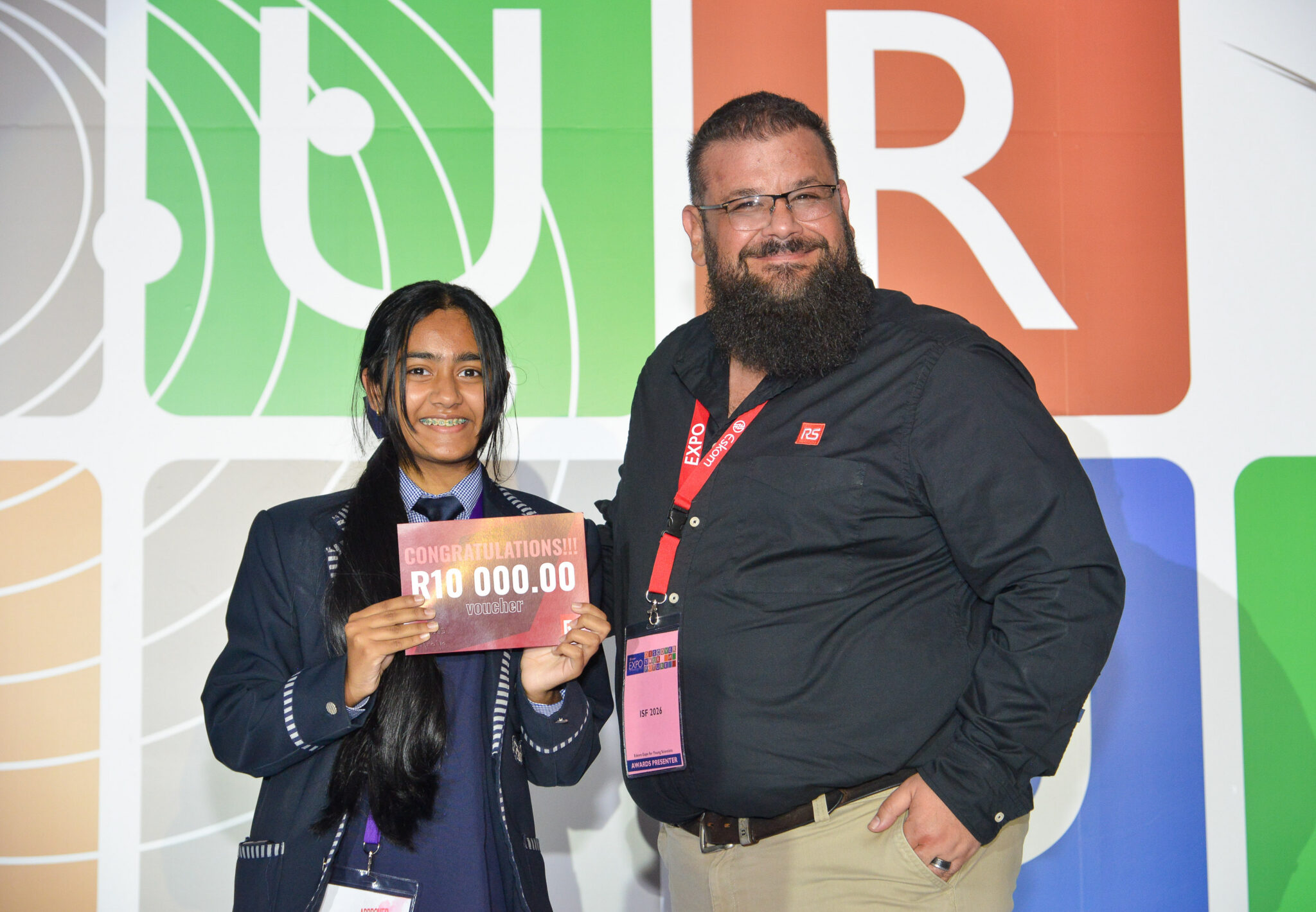
Local – IT Varsity graduate Layla Ahmed, 15, won three awards at the 2026 Eskom Expo International Science Fair for a project combining eco-friendly concrete with artificial intelligence. Alongside a silver medal as top junior in computer science, she received a special award from RS Group for an impressive engineering project and a second special award for an impressive coding project.
Speaking on Salaamedia with her father, Tauqeer Ahmed, Layla said the project built on her entry at the previous year’s Expo, where she proved that engineering plastic could be recycled into concrete. That earlier work relied on physical testing, and making and testing every mix took a great deal of time and money.
After qualifying as a Python full-stack developer, she put her coding skills to work by building an AI model to predict the best mix designs, letting her test smarter rather than test everything.
The process brought its own setbacks, however, when her test data clashed with the code of an open-source platform she had planned to adapt, causing her strength and density graphs to flatline.
“Instead of forcing it to work, I studied how their code worked, took key ideas and built my own model from scratch… It predicts the density, strength, mix designs, and optimal mixes from everything from 0% to 100% plastic replacement. Sometimes starting over is the best way forward,” she said.
Turning Industrial Waste Into Building Material
The plastic at the heart of the project is not ordinary household waste. It comes from an industrial manufacturer that cuts nylon, polyethene, and other heavy industrial-grade plastics, leaving offcuts that conventional recycling can’t handle.
Layla’s model was designed to find the optimal mix design for concrete made with this material, giving the waste a second life as a building product.
Tauqeer, a civil engineer at Transnet, said the code could also benefit the wider concrete industry by helping companies optimise their mix designs, leading to more effective mixing and less waste. He said the results of Layla’s experiments had surprised him, and that her lab work at a university had drawn the interest of a chemistry professor, who discussed further chemical analysis with her.
Wear-and-tear and fire-resistance tests could follow, along with testing against SANS standards and Agrément South Africa requirements, and he estimated that a product could reach the market within five years if it met those standards.
“It’s a waste that cannot be recycled, unfortunately. So it was interesting to see how it can be incorporated into concrete… One thing that Layla did prove was that it can be used in single-storey houses quite comfortably up to 80% and double storey as well, I think up to like a 60%,” he said.
Recognition For A Young Developer
Layla’s interest in technology was nurtured at home from an early age. As a child, she enjoyed creative activities such as drawing, painting and working with clay. At the same time, her father encouraged her curiosity about science and technology by buying her books and taking her to his workplace.
One of those books, Python for Kids, revealed her knack for coding. A few years later, when she was ready for something more advanced, several universities and training providers turned her away as too young, offering only basic puzzle-piece coding tools, until IT Varsity allowed her to complete its course.
Tauqeer said there were still difficult days when the code wouldn’t work, and her mother was there to encourage her through the frustration and tears.
Now in grade nine, Layla said she had not yet settled on a career but was interested in medicine, particularly surgery, or civil engineering like her father. Looking back on the Expo, she said one judge’s reaction had stood out above the rest.
“My most memorable reaction must be when one judge was completely shocked when I told him I had qualified as a Python full stack developer at IT Varsity. He couldn’t believe I was in grade nine and had already done that. It meant so much to me because it felt like all my hard work had been recognised,” she said.
Layla said she hoped her work would make a difference beyond the science fair, as finding the optimal concrete mix could support recycling and make housing bricks more affordable for communities. She encouraged other young people to believe in their ambitions, saying that if they could dream something, they could achieve it.
