Image: IOL
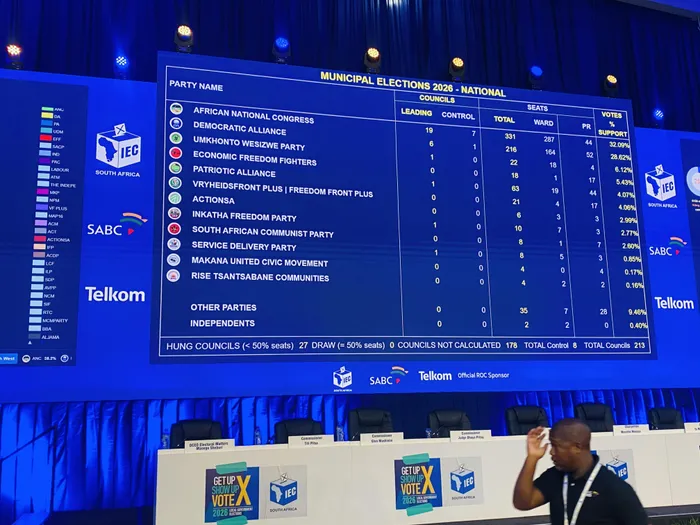
Local – The ANC is still the largest party in South Africa after the 2026 local government elections, but it won 30.76% of the vote and does not have a majority in most municipal councils. Parties will now have to negotiate coalitions in many municipalities.
The Electoral Commission of South Africa (IEC) announced the final results at the National Results Operation Centre in Midrand on Sunday night. About 14.9 million of the 29.2 million registered voters cast ballots, a turnout of 52%. This was higher than in 2021.
“The Commission is thus pleased to declare the 2026 Local Government Elections. We say this based on the findings of the Elections Satisfaction Survey 2026, which was tasked with assessing the voters’ view on the election process, including its integrity and operational efficiency,” IEC chairperson Mosotho Moepya said.
How The Parties Performed
The ANC won 3 246 council seats. The DA came second with 24.64% of the vote and 1 695 seats, and the MK Party was third with 9.76% and 785 seats. The EFF won 6.22% and 588 seats, and ActionSA won 5.67% and 313 seats.
Smaller parties and independent candidates also won seats. A total of 521 parties and 636 independents fielded about 137 000 candidates for 10 526 council seats. These were 4 485 ward seats, 4 340 proportional representation seats and 707 district council seats. Local municipalities will fill a further 994 district council seats by electing councillors from their own ranks.
“We are gathered here this evening to not only declare the 2026 Local Government Elections but also to pay tribute to all South Africans whose efforts in the various parts of our beautiful country made this evening possible. All 213 municipal councils have now been finalised and declared,” Moepya said.
Results By Municipality
Only 72 of the 213 councils have a single party with a majority. The ANC has outright control of 53 municipalities and leads in 128, while the DA controls 12 and leads in 32. The IFP and the MK Party each lead in 19 municipalities, with the IFP holding a majority in five and the MK Party in three. Rise Tsantsabane Communities controls one municipality.
Moepya said the IEC would now review how the elections were run. The voter survey found that trust in the commission remains high, although it has dropped gradually since 2016, and it also raised concerns about intimidation, impartiality and information gaps.
“We will examine the experiences of these elections honestly and systematically. We will listen to the concerns of voters, political parties, candidates, observers and our own staff,” he said.
