Image: Reuters
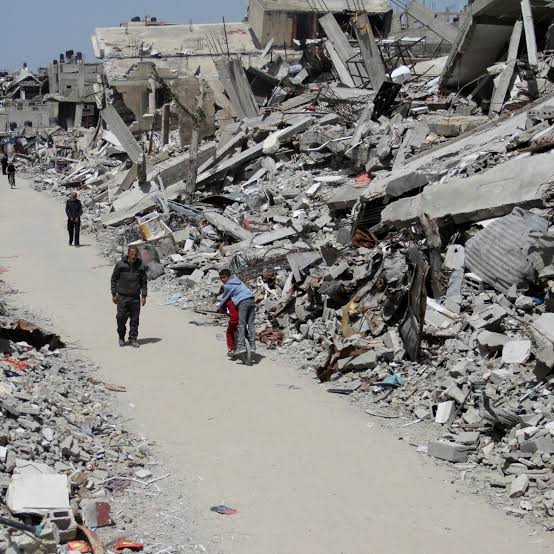
World – A senior Palestinian environmental official said Gaza’s soil, water and air must be properly assessed before reconstruction begins, after a new report found signs of contamination across almost the entire territory, raising concerns for public health, agriculture and future generations. The report, published on 23 November by Oxfam and the Conflict and Environment Observatory (CEOBS), identified indicators of potential contamination across more than 99% of Gaza, with risks including heavy metals, explosive residues and asbestos.
Saeda Shaebat, director of the Environment Quality Authority (EQA) Jerusalem office, said the munitions dropped on Gaza were equivalent to about 13 Hiroshima bombings, and that the crisis had affected every aspect of life, from food and air to the land where people grow their crops.
“The munitions have their toxic residuals, the gases they produce, and the deep craters that happen behind dropping these munitions cause severe contamination. These residuals are in the rubble, in the soil, in the air,” Shaebat said.
Reconstruction Risks
More than 60 million tonnes of debris remain across Gaza, the report said. Its lead author, Oxfam water and sanitation specialist Lama Abdul Samad, said fixing Gaza’s environment would be difficult because contamination was spread across rubble, farmland, water systems and soil. Israel’s Foreign Ministry dismissed the report, accusing Oxfam of sacrificing its credibility for activism.
Shaebat said workers rebuilding Gaza would be exposed to hazardous material in the rubble, and that reconstruction without a full assessment would be dangerous. Responsibility lay with those who carried out the assault, she said, adding that compensation should be examined under environmental and humanitarian law.
“We can’t ignore the social impact of the reconstruction. We can’t ignore how people react to our rubble containing the bodies of their beloved ones, maybe. And that’s why Palestinians must lead this work with the assistance of our friends all over the world,” Shaebat said.
Farming Under Threat
Gaza was once known for its fertile soil, where almost any crop could grow. The report said local agriculture had been ravaged, with 87% of Palestinian cropland damaged and more than one million olive trees uprooted by October 2024.
Shaebat said about 80 to 85% of Gaza’s agricultural land was either contaminated or out of reach. Some farmers were still trying to grow plants beside the crowded tents where they now live, she said. Restoring the soil would need technology and professional intervention, which the Palestinian government had called for at the latest COP summit.
“People must live. They need to live. No one is entitled to tell them that you can’t grow plants, you can’t eat. But we know that there are some dangerous aspects in that regard and that soil needs time to recover,” Shaebat said.
Shaebat called for the assault to stop and for restrictions to be lifted so Palestinian teams could enter Gaza, assess the damage and prioritise water and health needs. She said the work would need significant funding and environmental expertise to rebuild sanitation plants, water treatment facilities, and dump sites.
