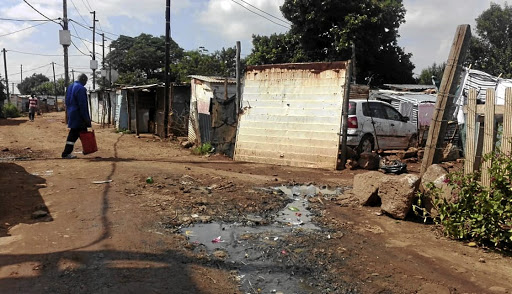
Itireleng informal settlement near Laudium, west of Pretoria Photo Isaac Mahlangu / Sowetan Live
Laudium – As the first light of Sunday dawned upon Itireleng , an unspeakable tragedy unfolded, shattering its fragile peace. In the relentless grasp of a devastating shack fire, five innocent children met a cruel and untimely end, leaving behind a community drowning in an ocean of grief. This grim incident serves as a stark reminder of the bleak realities endured by those residing in the overcrowded and impoverished informal settlements, where each day is a painful struggle for survival.
Firefighters rushed to the Itireleng informal settlement after receiving a frantic call at 04:00. The initial accounts suggest a dispute between two individuals escalated into this tragic event, said Thapelo Mohapi, Secretary General of Shack Dwellers Movement Abahlali baseMjondolo. This tragic event is not isolated and is symptomatic of broader social issues plaguing South Africa, rooted in poverty and desperation.
“I think it speaks to the situation of the social ills that we have in this country as a result of the poverty that is taking place. Therefore there’s a lot that is going on particularly in the shack settlements that are congested. If there’s a squabble between two people and they react in the manner that has happened in recent times, people are affected. This is very devastating. I remember I had a cousin who had gone to see her boyfriend, locked the house and the two children were burnt [in a fire that started].
Mohapi also recounted a deeply personal experience when his own shack fell victim to a fire that was started during the Covid-19 riots. In those harrowing moments, his foremost concern was the well-being of his children. Anxiety gripped his heart as he desperately searched for them, a torturous two-hour span that felt like an eternity.
The root causes of these horrific incidents
Though it’s undeniably unfortunate the children’s mothers, who happened to be two sisters, had left them unattended in the shack to indulge in drinks at a nearby tavern, Mohapi emphasised the outcome might have been markedly different if they were residing in a formal home. It is a possibility the mothers have done this before and locking the house was done to keep them safe.Tragically, this well-intentioned precaution inadvertently contributed to the devastating outcome.
The heartbreaking incident serves as a stark reminder of the grim realities endured by informal settlement residents. Numerous underlying factors conspire to perpetuate these tragedies, including poverty, overcrowding, inadequate infrastructure, and corruption, among others.
Seeking solutions
These are incredibly tough and major problems to take on. Addressing these issues requires a multi-pronged approach involving not only the government but also community members. It will take time to resolve them and with the huge amount of housing backlogs, time is not something people have. Instead, the process of reblocking should start in an effort to avoid any more of these incidents. Reblock could save thousands of lives if a fire has to break out again.
“You cannot address the issue of housing overnight. We have a backlog of about 200 000 in Johannesburg and Cape Town is 250 000. These bigger cities have a lot of shacks and housing backlog. The only thing is to actually deal with the situation that we are facing right now. That is reblocking. Reblocking means we try to find land elsewhere and remove people so that there is separation between the shacks. So, if an incident happens in one house, it does not affect another person. We are saying that we need to upgrade the settlement and the first step is to reblock.”
Another solution offered by Mohapi is disaster management educating the community. Residents need to have an awareness of fire safety and emergency procedures. Efforts should focus on helping people prioritise lives over belongings during crises.
“We need to have people who have experience in [handling] disasters because one of the things that have happened, in this particular case, has been that people in the informal settlement worry about their belongings and then the lives of other people. The first step when there’s a fire, you try to remove as much as you can of your belongings. Nobody asks if there’s children in this house and so forth and so on. We are trying to get people with experience of disasters and educate each other about the situation that we are facing because shack fires are here to stay unfortunately.”
Mohapi and his organisation have engaged the government and suggested building proper housing in informal settlements to eliminate shacks.
“Our proposal [to the government] was to build formal houses where people are living but if you need to relocate them then try some way of protecting the land that is there but we know it will not happen. Some of the ward councillors, officials in the municipalities are actually involved in shack farming. This is where officials are renting out shacks.”
Mohapi and his organisation discovered, in the Kennedy Road informal settlement, a number of shacks were being rented at an estimated R40 000 a month.
This shack fire which claimed the lives of five innocent children is a stark reminder of the urgent need for change. It is a call to action for South African authorities and communities to work hand-in-hand to create safer, more dignified living conditions for those residing in informal settlements. The time to address these systemic issues is now, to prevent further heart-wrenching tragedies and to offer hope to those who need it most.
