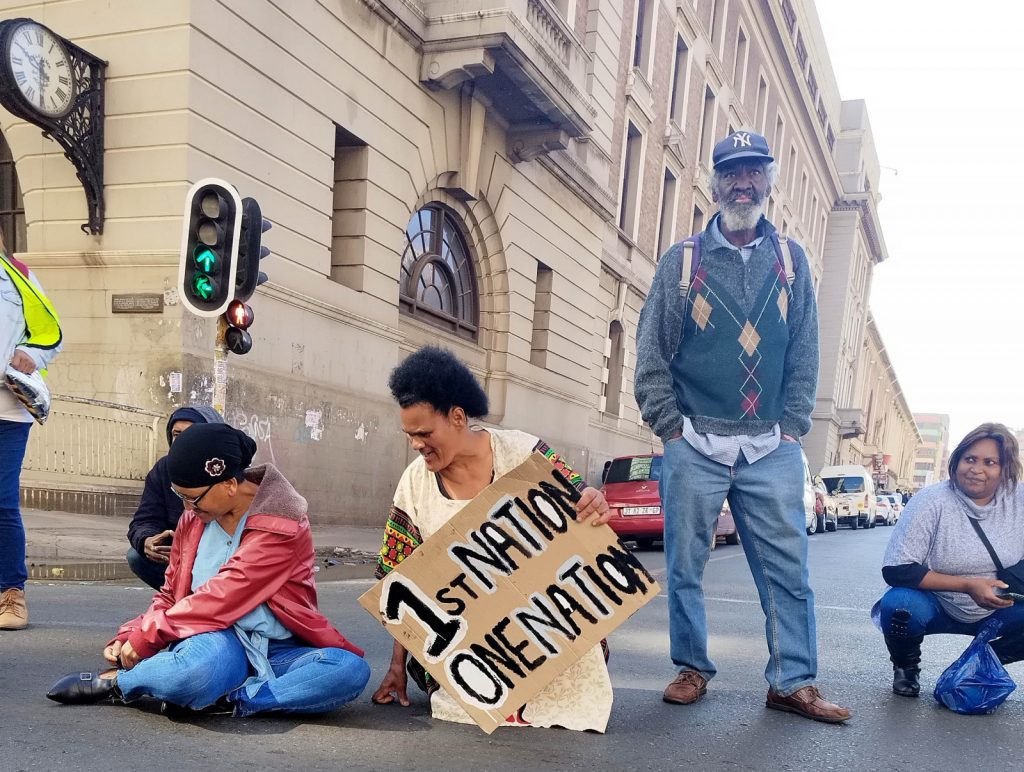
Image Source: The Mail & Guardian
Local – Activist Christian Martin has applauded the leadership of the Khoi and San communities in the Western Cape for what he described as a historic and courageous move in their long fight for justice.
His remarks followed a Cape Town court ruling granting the City authority to prevent members of the Khoi community from occupying land in Mitchells Plain.
This decision has sparked renewed debate over land rights, recognition, and the legacy of South Africa’s first people.
Martin said the case was not simply about property ownership or municipal procedure but about the broader struggle for dignity and belonging.
He commended community leaders for their commitment to pursuing the issue through formal structures.
“I want to actually congratulate the leadership of the Khoi and San in the Western Cape for this bold step that they have made by taking this land story so seriously,” he said.
“By doing this, the Khoi and San are taking their rightful place in society and in the structures of government itself. For too long, their voices were ignored, and their rights dismissed — this moment shows that they are no longer willing to accept being treated as invisible.”
He drew parallels between the community’s struggle and a biblical story of resistance, describing the power imbalance they face. Martin noted that the case represented far more than a legal setback for indigenous people.
“It is truly a David and Goliath situation that has been taking place in the Western Cape,” he added.
“The city, with all its power and resources, stands against communities who only seek justice, heritage, and belonging. Yet, like David, we must remember that courage and truth often outweigh the strength of any giant.”
City’s Defence and Historical Exclusion
The City of Cape Town defended its actions by saying the decision was necessary for orderly urban planning. Martin, however, argued that this justification disguised a deeper and continuing injustice.
He said the ruling should not be viewed as a loss but as a wake-up call to the Khoi and San people to reclaim their agency.
“It’s not an eviction notice that has been given; it’s just a notice not to allow people to invade land,” he clarified.
“We must not confuse this with eviction. It is strange for me, as a Khoisan, to hear we are invading our own land. You can’t invade your own land — you can only reclaim what was stolen from you.”
Martin described the framing of the Khoi and San as “invaders” as deeply insulting and historically inaccurate.
“You can’t invade your own land… It’s just to take back what has literally been stolen from us,” he said.
“That’s the heartbreak of our history — to be told that returning home is a crime, when it was our ancestors who walked this soil first.”
Martin said the struggle over Mitchells Plain land could not be separated from the broader historical erasure of the Khoi and San people.
He explained how apartheid laws had deliberately stripped them of their indigenous identity, replacing it with a term that robbed them of heritage and power.
“A coloured means nothing,” he said.
“If we had been left as Khoi and San, those terminologies of our ancestors and nations, we would have had a better claim to the land. But they took our names, our history, and our right to be recognised as the first people of this country.”
Recognition and the Path Forward
Responding to calls for a unified South African identity, Martin stressed that equality cannot exist without acknowledgement of the country’s first people.
He said the Khoi and San had long been excluded from empowerment policies and even denied African status under current legal definitions.
“It will never move forward when you move away suddenly after 30 years of democracy,” he asserted.
“How can we move forward when we were never even included in the journey? The Khoi and San were excluded from the very beginning of this democratic process — we were never invited to the table where decisions were made about equity and empowerment.”
Martin added that the next phase of the struggle must take place in the highest court in the land. He said the fight for official First Nation recognition remained central to achieving lasting justice.
“Until we win this in the Constitutional Court… we can go nowhere soon,” he said.
“That’s where our future lies — in being recognised not as forgotten descendants, but as the first people of this land. Only then will South Africa’s democracy truly include all who belong to it.”
