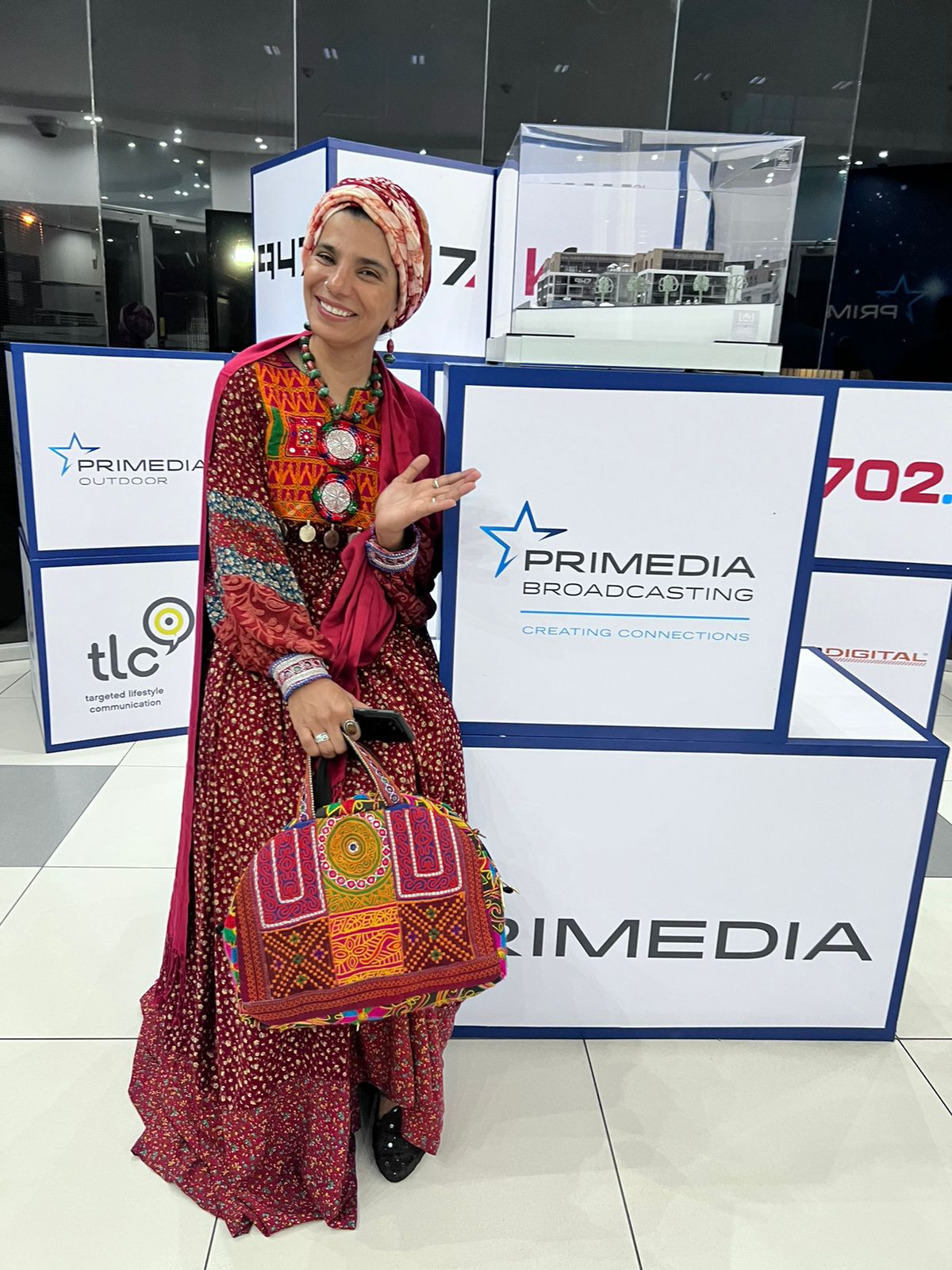
South Africa – Afghan-Canadian Humanitarian and founder of Dream Voice Act, Nadima, has been touring South Africa with the intention of educating people on Afghanistan. As part of her two-week tour, she sat down with 702 talk show host, Aubrey Masango to talk about Afghanistan, the past, present and future.
It has been a year since the United States decided to withdraw their troops from Afghanistan and the Taliban came into power. Many people were against this decision believing it would do more harm than good. Nadima believes the healing process has begun and it is for the best that Afghanistan is back in the hands of Afghans.
“To have our own people take back their community and take the leadership back, it is good because it is my people now. Through thick and thin, through the good, the bad and the ugly. They are my people. That makes me feel good. Do we have challenges? Of course, but now those challenges are our challenges, and we will deal with them and take care of them. Of course, it is not easy but we are determined to make it good. There’s a lot of healing that needs to take place and that healing has to be given space. We have a lot of growing to do.”
Afghanistan’s present is being destroyed by those from the past
If a country is to grow, they need to know their past so that they know what mistakes to avoid. However, Afghanistan’s past is filled with war, death and disaster, not a result of their own misdeeds. For Nadima, one can either worry about the past or focus on the present to build a better future. She has decided to do the latter.
“Digging the past usually becomes a distraction. I would rather focus on the present and really figure out solutions because winter is around the corner. Yes, people have left, Americans have left and a lot of countries have left. They have now decided on how my people are going to live. They’ve put all these sanctions on my community. They don’t want to take accountability, but they want to create more destruction and force neighbouring countries to stop supporting us. That is so cowardly and inhumane. It is wrong.”
The different narratives about Afghanistan being played out in the media
Currently there are many narratives about Afghanistan. Masango pointed out that in times like this, many narratives can exist. Victims can have fragmented narratives, and this can lead to a point where there isn’t one set narrative that tells the true story. For Nadima, it doesn’t matter how many narratives there are. It only matters that the narratives are told from a place of truth.
“We all have to have different narratives because we are individual people. Every human being is its own universe, but all narratives have to speak the truth. It is okay to have many narratives, it is okay to have one, but it has to be the truth. In Afghanistan and many countries, the narrative is one sided. Often it is in the favour of the people creating the oppression. There is something off in Afghanistan. If there are a thousand good things taking place in Afghanistan and there is one bad event, it completely paints the whole country.”
Nadima believes the way Afghanistan has been narrated to the world has set the country up for failure. Every bad thing is published but every good thing is kept under wraps and hidden away from the world. This in turn creates an image of the country which isn’t true.
SMread: Nadima Noor on The Talking Point with Cathy Mohlahlana
Afghanistan is a broken country, not a poor one
For many years different images have been shown to the world about Afghanistan. In the minds of most people, it is a poor country that has nothing to offer. This is far from the truth. Afghanistan is rich in many natural and valuable resources. However, the country has been broken to a point where these resources are currently unable to help the people, explained Nadima.
“The beauty of Afghanistan is that we are such a rich country. We are a very resourceful country and we have resources that the world is in desperate need of. We have lithium, tin, copper, everything. The people of Afghanistan, we are not poor. We have been broken. My country has been broken. How do you expect a community to prosper in a direction of positiveness and goodness if I am continuously breaking you down?’”
The United States destruction of Afghanistan
After 9/11 the United States were looking for answers. They wanted to know who was responsible. Their search took them to Afghanistan. Their search for the perpetrators of 9/11 led to the destruction of a country while the world watched on. While Nadima has moved on from this, she cannot understand how and why the United States is still being allowed to dictate the lives of the Afghans.
“Now 21 years later you decide to leave. You have left so who are you to decide we are going to be blocked from support? Why are you allowed [to do this] and what is going on with the world? The UN claims to care about women’s rights so why are my women struggling? When did you last see on CNN or BBC someone bringing justice to my people? Now I want to know how this is still allowed?”
SMread: ‘The Taliban liberated us’- Afghan activist
The major people of Afghanistan’s politics
Afghanistan is a country like any other. They have their own tribes, their own communities, community leaders and elders. With the new government they also have ministers and leaders in every province and village. For Nadima, the way for Afghanistan to be governed is through a monarch system.
“Democracy is not going to work for us. We have a bloodline of kings and queens. I am for monarchy. We will do well in that. We have different tribes because we’ve had so many invaders. That has always been used to divide us. It is kind of similar to South Africa.”
Keeping a close hold on Afghan cultures
When a country is invaded or colonised, the people of the land are stripped of who they are and their past. Masango used South Africa as an example of this. Once democracy sets in, the old ways start to dissolve. Languages have been lost and histories have been rewritten to suit the narrative of the colonisers. Masango wanted to know if Afghanistan is suffering from the consequences that South Africa faced when democracy came in. According to Nadima this has not yet happened in Afghanistan, and she hopes it never does.
“In Afghanistan we still hold onto the language. We are still trying to hold on to our clothes and we are still trying to hold on to the foods. This is why I understand why this current government is so careful in this whole education that they are pushing on us. This education is not creating independence in our community. It is setting them up for factories and this Western system that has failed in their countries and now they are trying to enforce it on us.”
Afghanistan is a land of farmers. They produce some of the best farming products. The way the West has been trying to introduce their systems onto the country has Nadima fearing that Afghanistan may lose a lot of their farmers. The West has already created fear in those Afghans who have left. They have made Afghanistan ugly to them all, explained Nadima.
Education is important but ensuring people aren’t starving is more important
Since the Taliban have come into power many issues regarding women have been brought up. Nadima’s first work in Afghanistan was highlighting several of these issues including women’s education. However, she feels the way she raised the issue and how it is currently being raised is vastly different.
“I used a narrative that was humble and gentle. That had empathy and remorse and it wasn’t attacking but it showed the importance of a mother’s knowledge on health, cooking properly, hygiene, nurturing a child when they are scared and consoling a husband when he is stressed … I feel the way that [education] is pushed to my people and especially my women, I feel like women are used as a pawn. If they cared so much about women’s education, I’ve proposed online education and there’s so many schools that are taking place indoors.”
The main reason Nadima has not talked about this issue is that currently many Afghans don’t have food or have their basic needs met. There are no solutions being offered, just demands from people.
Nadima wants everyone to have an education but that can’t be achieved without the proper resources. She believes she has the backing of Afghans. For everyone to enjoy their rights, resources have to be available. For that to happen, the world needs to support Afghanistan just as they wish to be supported. It is only through this, Afghanistan can truly reach its potential and its people can live their lives as they wish.
