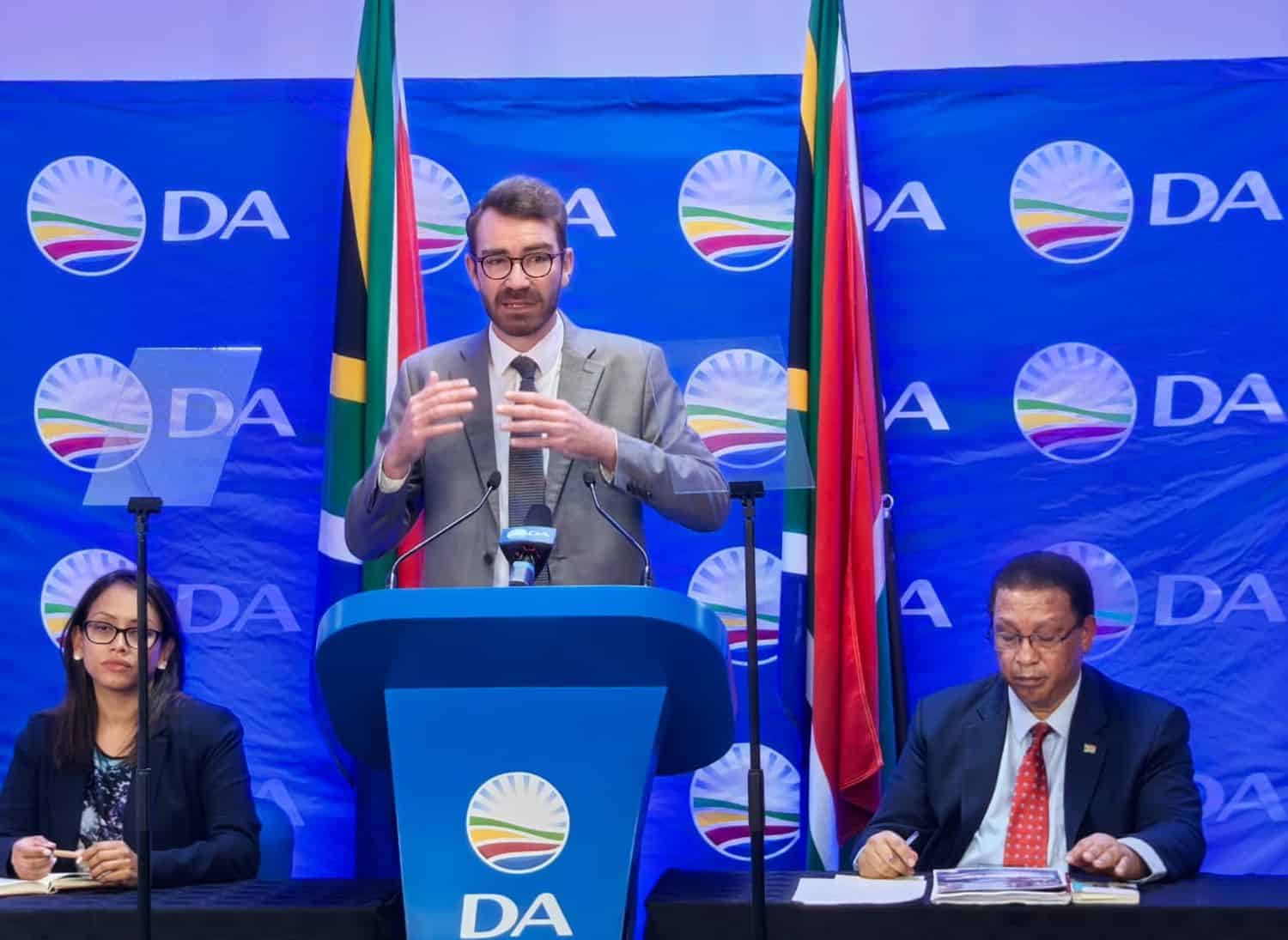
Image Source: The Citizen
Local – The Democratic Alliance (DA) has proposed the Economic Inclusion for All Bill, which seeks to reform South Africa’s empowerment framework by focusing on poverty as a measure of disadvantage instead of race.
The Bill follows the party’s Plan to Turbocharge the Economy, released two months ago, which identified key obstacles to growth and job creation.
The DA said the Bill aims to replace what it called “years of ineffective ANC empowerment policies that have left the majority of South Africans unemployed, impoverished, and hopeless.”
The party highlighted that 44 million citizens remain in poverty while 12 million are unemployed, arguing that this is “not the inclusive country we envisioned building when we lined up to vote on 27 April 1994.”
New Bill Aims to Reform Procurement
The DA said the new Bill seeks to amend the Public Procurement Amendment Act of 2024 to remove race-based preferential procurement clauses.
It will instead introduce a simplified, outcomes-driven model that rewards job creation, poverty reduction, skills enhancement, and environmental sustainability.
The DA explained that the Bill’s scorecard would focus on three categories — Value for Money, Economic Inclusion, and Disqualification Criteria — to ensure fairness and development-focused procurement.
The Value for Money category would weigh 80 percent and assess cost-effectiveness, capacity, and reliability. The remaining 20 percent would measure economic inclusion through social impact and empowerment initiatives.
The party said its approach is designed to reduce red tape and open opportunities for small businesses.
“The ANC’s policy is only for cadres, while the DA’s policy demands no political connections,” the party said, arguing that empowerment must reach ordinary South Africans, not the politically connected elite.
DA Slams ANC Empowerment Policies
The DA criticised the ANC’s Black Economic Empowerment policy, saying it had entrenched inequality and corruption.
The party pointed to research showing that “conservatively, R1 trillion has been moved between under 100 people since 1994. The same people have been empowered and re-empowered over and over,” said Professor William Gumede of the Wits School of Governance.
He added that “South Africa’s BEE model has created a model of corruption because people set up companies just to get a contract.”
The DA cited the Transnet locomotive procurement scandal, where R6 billion in kickbacks were channelled to Gupta-linked companies, as proof of corruption under the guise of transformation.
It also referred to the R2 billion looting at Tembisa Hospital and the murder of Chief Auditor Mpho Mafole as further examples of how BEE had fuelled abuse and inequality.
