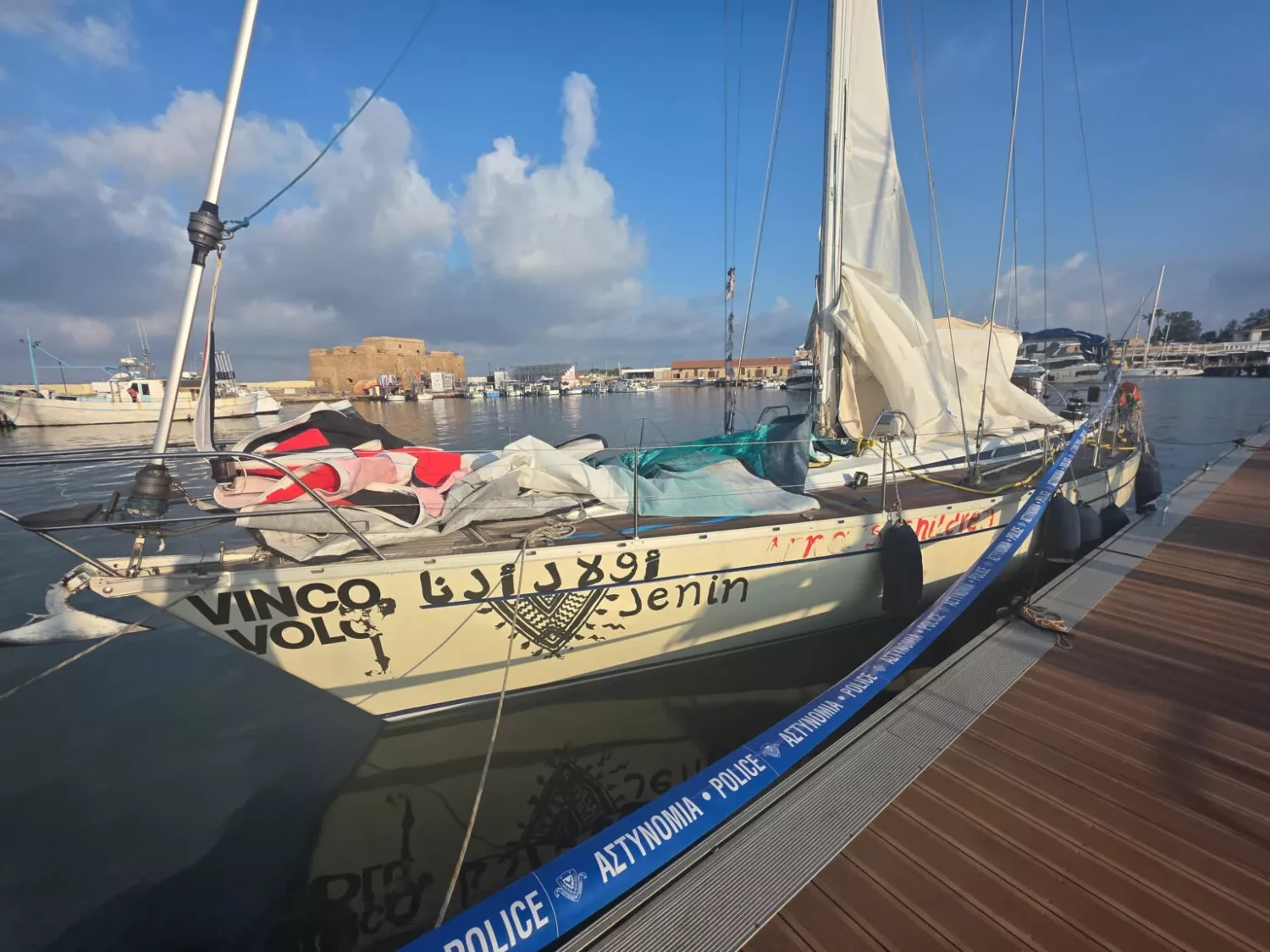
On Sunday, 17 May 2026, the Vincovolo set sail from the Turkish resort town of Marmaris for the ruins of Gaza, Palestine. The single-hulled sailing yacht, one of more than 100 vessels hauling life-saving humanitarian aid across the Mediterranean, carried nine activists from five countries. Their mission was to breach the Israeli blockade.
One of them was Hajar Kagiso Al-Tha’irah Ahjum Mathee. When the call came for volunteers to participate in the Global Sumud Flotilla’s Spring 2026 Campaign, the 22-year-old student from Cape Town, South Africa, unhesitatingly put her hand up and joined more than 400 activists from around the world.
“Palestinians have been begging, screaming, crying and asking us to come to their aid for decades. We’ve been failing them,” she would later explain at a press conference in Johannesburg, soon after attempting the perilous journey.
While Mathee departed for Gaza, where half the population faces food insecurity, another young South African, Yusuf Rahman, held the South African flag with pride on a separate vessel. “I’m amongst one of the very few people in this world that can proudly hoist my flag next to the Palestinian flag without feeling as if my government is complicit,” he remarked.
It was a proud moment for a country whose own struggle for freedom was intimately bound with the Palestinians’ quest for self-determination. Hajar and Yusuf were not the only South Africans participating in the latest effort to deliver much-needed food, baby formula, school supplies and medicine to the war-torn Palestinian enclave. Five others — Qutb Hendricks, Ebrahim Peters, Faizel Moosa and Mogamed Faeek Ariefdien — boarded various other flotilla ships with the same intention.
As their journey proceeded apace, the activist seafarers remembered the ill-fated humanitarian expedition of the MV Mavi Marmara. In 2010, with more than 500 brave souls aboard, the lead boat in the Gaza Freedom Flotilla was violently intercepted by Israel. Nine people were killed and dozens were injured. The prospects for the latest undertaking were dim.
The next day, trouble loomed on the horizon. News began spreading that the Israel Defence Force (IDF) was abducting voyagers on various boats. It was a stressful time, Yusuf recalls, but “not once did we feel like we should give up”.
With the IDF closing in on the humanitarians, Hajar sent an urgent missive back home: “Behind us”, she wrote in a WhatsApp message at 12:21 PM. And, three minutes later: “Coming for us”.
At 12:41 PM, members of the IDF intercepted Vincovolo, just a day into her journey and less than 300 kilometres away from Gaza. They rounded up the yacht’s passengers, marshalled them to the deck and cut the camera feed. Blackout.
Among the South Africans, captives were placed on either one of two floating prisons. “One seemed to have more violence than the other,” Yusuf remembers. “From the moment I entered, I saw droplets of blood”.
Yusuf, a lean and slender man, was thrown into a container. Six military men surrounded him, each taking turns to kick him from one side to the other. Then came the tasers, rubber bullets, handcuffs and cable ties — instruments of torture Palestinian recognise. Throughout the ordeal, he thought of them.
“The level of torture that we went through in that moment, all you wanted was for it to end. We knew we will leave eventually; we knew that at the back of our head. What about those people [Palestinian prisoners] who have no certainty if they will ever leave?” he asks.
From there, detainees were taken for processing at the Port of Ashdod, near Tel Aviv. “Why did you come to Israel?” an immigration official demanded of a manacled Qutb Hendricks. “I wanted to go to Gaza,” he responded. “I’m a chef and I want to cook for my fellow brothers and sisters.” Unmoved by his compassionate drive, officials bundled the chef and 11 others into a prison-bound vehicle.
Female prisoners were stripped of their hijab. “We were able to make scarves out of t-shirts,” Hajar says. “That t-shirt only lasted for so long because as they pulled me off the prison boat and into Ashdod port, they ripped that shirt in half. They ripped it into multiple pieces and they started laughing at me, and then they dragged me by my hair through Ashdod port. Her voice dips as the humiliation of the moment strikes again with full force.
After two days of radio silence, the rest of the world finally received news about the fate of the detainees. On the evening of Wednesday, 20 May, Adalah, an independent legal centre based in Israel, confirmed that they were being transferred to Ktzi’ot Prison.
Ktzi’ot is Israel’s largest detention facility. Located in the Negev Desert, it is notorious for savage treatment towards inmates. Starvation, beatings and sexual abuse are common occurrences within its cells. Detainees, despite holding foreign passports, were not spared from the abuse familiar to Palestinians.
After being served meagre portions, the activists settled into metal beds without mattresses. Their first night in an Israeli jail. “The lights went off,” Hendricks recalls. “We were about to sleep when, all of a sudden, out of nowhere, a group of people came into my cell.” Among them stood a stocky, spectacled politician: Itamar Ben-Gvir, Israel’s national security minister, taunting tied-up detainees.
The next day, Thursday 21 May, wearing the same dishevelled clothes they had on the day they were captured, the detainees were loaded into prison vehicles. “Are we being transferred?” Mathee wondered “What is actually happening?” Soon, they found themselves at Eilat Airport. There, three Turkish planes awaited the released inmates.
On the morning of Saturday 23 May, the six South African detainees arrived at Johannesburg’s OR Tambo International Airport. There, they were welcomed by a throng of family, friends and supporters alike before being ushered into the media centre adjacent to the arrival hall.
Reflecting on the ordeal, Faizel describes it as “a little peek through a tiny little hole of what Palestinians go through every single day”. Yusuf laments the lack of support from the global community. “We were four hours away from giving people food but we failed because we could not get enough support from humanity to carry this mission through”. If given another opportunity, Hajar says, “I will definitely go again”.
SMread: SA is still selling coal to Israel — and activists want it stopped
Image: Global Sumud Flotilla vessel “Vincovolo”. Credit: Phile News.
