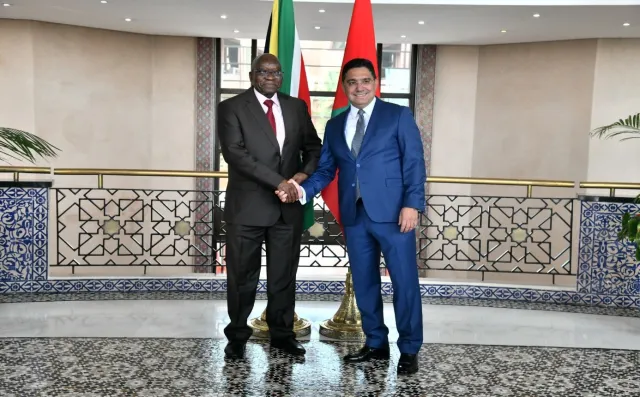
Former South African President Jacob Zuma has caused a significant political uproar following a visit to Morocco on 15 July, where his uMkhonto weSizwe (MK) Party officially backed Morocco’s sovereignty over the disputed Western Sahara region.
The move is a stark contradiction of the African National Congress (ANC) and South Africa’s historical support for the Sahrawi people’s self-determination, leading to fierce condemnation and accusations of betrayal from his former party.
The controversy erupted after Zuma, accompanied by MK Party officials, met with Moroccan Foreign Minister Nasser Bourita in Rabat. The MK Party subsequently released a policy document endorsing Morocco’s autonomy plan for the region as a “realistic alternative.” This position directly challenges the African Union’s stance and decades of South African foreign policy, which has consistently supported the Polisario Front, the liberation movement representing the indigenous Sahrawi people.
The reaction from the ANC was severe. Secretary-General Fikile Mbalula publicly branded Zuma a “sellout,” stating the party was unsurprised by his actions. “It is shameful that a former leader of a liberation movement is betraying our historical mission,” the ANC said in a statement, condemning the move as an erosion of South Africa’s international standing and anti-colonial principles.
SMread: South Africans mobilise against complicity in Gaza Genocide
A controversial shift
The Western Sahara, a former Spanish colony, was annexed by Morocco in 1975, leading to a protracted and unresolved conflict. South Africa, under the ANC, has been one of the most vocal supporters of the Sahrawi Arab Democratic Republic. Zuma’s new position is therefore seen by critics as a monumental diplomatic reversal.
The Pan African Forum described Zuma’s stance as a “betrayal of African solidarity,” arguing that endorsing Morocco’s occupation is equivalent to endorsing colonialism. Political analyst Joe Mhlanga echoed these sentiments, telling IOL that the move is “not different from supporting Israel over Palestine, because history reminds us that Morocco is the oppressor who continues to illegally occupy the Western Sahara.”
In its defence, the MK Party, now the third-largest party in parliament, framed its decision as a strategic partnership for African unity and territorial integrity. A policy document from the party argued that “The Western Sahara was a part of Morocco before Spanish colonisation in the late 19th century,” and that historical ties, including Morocco’s early support for the original uMkhonto weSizwe, justify the new alliance.
This incident has exposed deep divisions, not only between the MK Party and the ANC but also within the MK Party itself. Former MK Party Secretary General Floyd Shivambu called Zuma’s recognition of Moroccan sovereignty “opportunistic.” The political fallout highlights the volatile landscape of South African politics and raises serious questions about the country’s future foreign policy direction, with this act of perceived betrayal at its centre.
Image credit: The Voice
