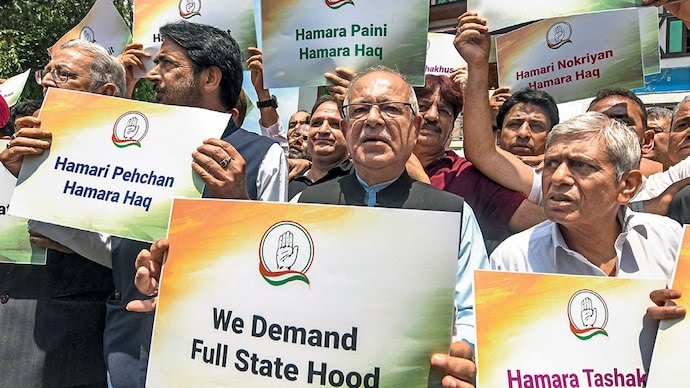
Six years after the Indian government revoked Jammu and Kashmir’s special status, the region remains caught between promises of development and a reality marked by unrest and political fragmentation.
Article 370 once allowed Jammu and Kashmir semi-autonomy over its governance, while Article 35A safeguarded land and employment rights for locals. Both were removed in August 2019 by the Bharatiya Janata Party-led government, with claims it would integrate the region into India’s union and usher in peace.
Instead, Journalist Irfan Quraishi noted a major political shift: “There is a huge transition from the demands of resolution of the Kashmir issue to the demands of restoration of statehood in Article 370 and 35A.”
The move was met with opposition from across Kashmir’s political spectrum. Mainstream parties, separatist groups, and rights activists have called for the reinstatement of statehood, citing concerns about identity loss, demographic change, and political disenfranchisement. New land laws allowing non-residents to buy property have intensified fears that Kashmir’s Muslim-majority character is under threat.
SMread: National dialogue in peril as key foundations withdraw support
Local and international resistance
While the Indian government insists the abrogation will deliver stability and progress, the ground reality remains tense. Political leaders have been detained, protests suppressed, and security forces remain heavily present. Quraishi pointed out, “Jammu and Kashmir is struggling politically as well as the resolution of Kashmir is somewhere lost in between the conflict of interests.”
Internationally, Kashmir’s visibility has faded, even though United Nations resolutions still recognise it as a disputed territory. Khan warned that without global attention, the path to a fair resolution will remain blocked. As Quraishi added, “There are also people across the globe who definitely want a better resolution for Kashmir.”
With parliamentary debates and court hearings expected in India, Kashmir’s political fate hangs in the balance. The calls for dialogue remain clear: without meaningful engagement from Kashmiri representatives, India, Pakistan, and the international community, the region’s struggle for justice and identity will continue.
Image: AFP via India Today
