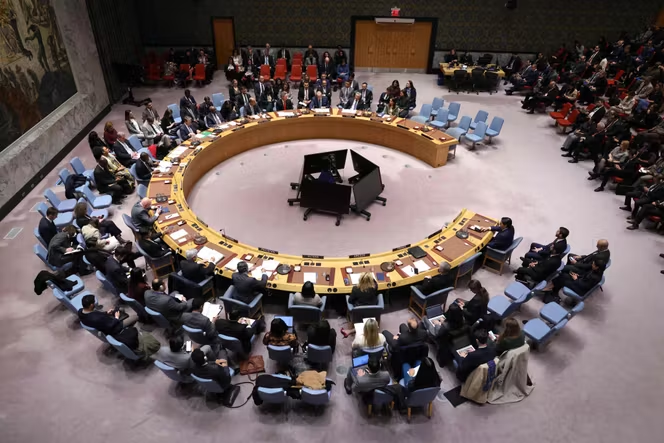
The United Nations Security Council has endorsed a United States-drafted resolution for post-war Gaza. The plan, proposed by US President Donald Trump, passed with 13 votes in favour. Russia and China abstained from the vote. It establishes a new framework which includes the deployment of an International Stabilisation Force (ISF).
The resolution has been met with significant opposition. Hamas immediately rejected the plan, describing it as a form of “foreign guardianship”. It stated it would not agree to disarm.
Israeli Prime Minister Benjamin Netanyahu also reiterated his government’s strong opposition to a Palestinian state. This raises questions about the Gaza plan’s implementation.
SMread: Mystery surrounds Palestinian refugees’ arrival in South Africa
A new framework for Gaza
The US-led resolution creates two new bodies. The first is the Board of Peace (BoP). This transitional body, chaired by Donald Trump, will oversee Gaza’s governance and reconstruction.
The second is the International Stabilisation Force (ISF). This force will be tasked with securing Gaza and overseeing the disarming of groups like Hamas.
Meanwhile, the humanitarian situation in Palestine is dire. In Gaza, displaced people face a harsh winter in flooded tents. Humanitarian aid is severely restricted by Israel. In the West Bank, violence from Israeli settlers is escalating. These attacks, often backed by the Israeli military, target Palestinian farmers and communities.
Jenin-based journalist Osama Nazzal described it as an “all-out war” against Palestinians. This includes economic pressure and a de facto annexation of territory. The success of the Gaza plan seems uncertain amid this complex and volatile environment.
Image: ANGELA WEISS/AFP.
