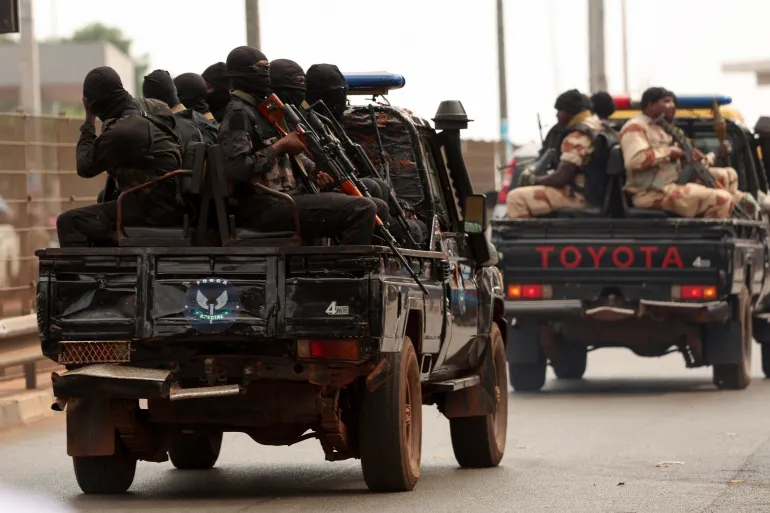
Image Source: Al Jazeera
Africa – The South African government has condemned the unconstitutional seizure of power by military elements in Guinea-Bissau, warning that the takeover threatens both the country’s democratic process and regional stability.
The intervention unfolded during a critical phase of the electoral process, with reports confirming the arrest of the sitting president, the suspension of state institutions, the closure of borders, and the imposition of a nationwide curfew under martial law.
“The Government of the Republic of South Africa condemns the unconstitutional seizure of power by military elements in Guinea-Bissau.”
“The timing of this act, during a critical phase of the democratic electoral process, demonstrates a profound disregard for the constitutional order and the sovereign will of the people of Guinea-Bissau.”
South Africa has reiterated its commitment to continental democratic norms and the African Union’s firm stance against unlawful changes of government.
Authorities said stability in Guinea-Bissau remains essential for regional security and democratic integrity.
“In unwavering support of the African Union’s principle of ‘zero tolerance’ for unconstitutional changes of government, South Africa calls for the immediate restoration of the legitimate civilian government and the unhindered completion of the electoral process.”
The government further appealed for political restraint and cooperation among national stakeholders. South Africa confirmed that it would continue working with regional partners to support a return to constitutional order.
“We urge all national stakeholders to pursue peaceful dialogue and affirm our commitment to work with the African Union and ECOWAS to support a swift return to constitutional order and lasting stability in Guinea-Bissau.”
Deep-Rooted Instability Behind Latest Coup
Researcher and Political Science Lecturer at the University of the Witwatersrand, Dr Gwinyai Taruvinga, says the latest military coup in Guinea-Bissau reflects long-standing political instability rooted in weak institutions and persistent military interference.
The military takeover followed reports of gunfire near the presidential palace, the electoral commission and several government ministries, locations central to confirming the outcome of the country’s elections.
While the coup leaders claim their intervention was aimed at preventing electoral manipulation and corruption, Taruvinga said similar justifications have been used to legitimise past takeovers across the continent.
“It is very interesting because it goes back again to how exactly you define a military coup… I’m reminded of the military coup that occurred in Zimbabwe in 2017… and this is very similar to the statement that the military in Guinea-Bissau also released.”
Guinea-Bissau has experienced a continuous cycle of military takeovers since gaining independence from Portugal. This pattern has weakened democratic institutions and normalised military intervention in politics.
“If I’m not mistaken, it should be the eighth or ninth military coup since they gained independence from Portugal … This again speaks to the point that you’re making, that this is not new to Guinea.”
Military Power and the Weakening Social Contract
Across West Africa, Taruvinga said the growing prominence of the military in politics is closely tied to governance failures and institutional decay.
He said the breakdown in accountability has weakened the relationship between governments and citizens.
“There seems to be an institutional weakness… linked to what in politics we call the social contract… but what we are seeing now… is that there seems to be a weak social contract.”
As public trust collapses, space is created for non-democratic actors to intervene. The military often steps into this vacuum under the guise of restoring order.
“When there’s a disjuncture between the government and the citizens, there’s often a power vacuum… the first thing being a military intervention … [and] the army is then taking advantage of those.”
