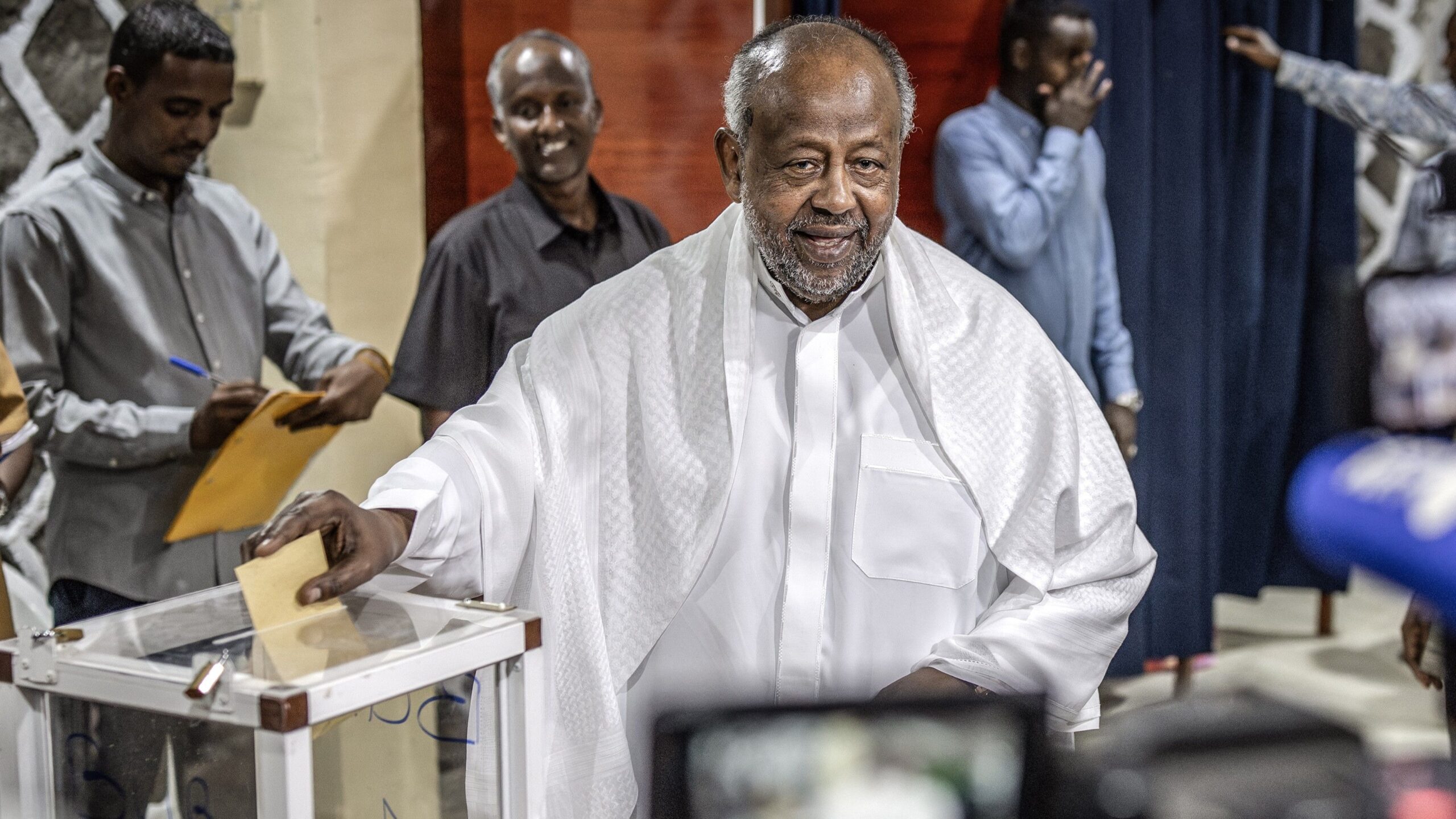
Image Source: BBC
Africa – According to Orapeleng Matshediso, Research Associate at the University of Johannesburg’s Institute for Pan-African Thought and Conversation, the reelection of Djibouti’s President Ismail Omar Guelleh after more than 26 years in power proves that there is no real democracy in the Horn of Africa nation.
Guelleh has claimed a landslide victory in the country’s latest election, securing his sixth consecutive term in office. He first assumed the presidency in 1999 after being handpicked by his predecessor and uncle, Hassan Gouled Aptidon.
His sole opponent, Muhammad Farah Samatar of the Unified Democratic Centre Party, secured just 2.19% of the vote and holds no parliamentary seats, while the country’s two major opposition parties have boycotted elections since 2016.
Matshediso pointed to a pattern of constitutional manipulation designed to keep Guelleh in power, arguing it exposes the hollowness of the country’s democratic institutions.
The constitution was amended in 2010 to remove term limits, and again in 2025 to lift an age restriction that would have barred Guelleh from standing. Each amendment, he suggested, was engineered at precisely the moment it served the incumbent’s political survival.
“In 2010, he had to go through the coalition of his political party, amend the constitution because it had a term limit, when they realised that the term limit was going to disadvantage him to stand for the election in 2016. They amended the constitution again in 2025 in October and November, because the constitution was quite clear in terms of the age limit.”
The Legitimacy of the Vote
The legitimacy of the vote has been further undermined by concerns about electoral administration. In 2020, mass protests erupted calling for an overhaul of the electoral commission, which opposition parties said lacked independence.
The reported figures, an 80% voter turnout and a 97% result for the incumbent, mirrored the contested 2021 outcome.
Matshediso said the treatment of those protesters remained a key reason to doubt the process’s credibility, adding that the absence of a free press meant the results were announced exclusively through state-owned media, with no independent verification.
“The question comes: are they legitimate? Because of what happened in 2020, where the protesters, peaceful protesters, were dealt with by the security agency.”
Djibouti’s strategic position near the Red Sea and Suez Canal has attracted military bases from the United States, China, Japan, France, and Italy, with 70% of the country’s revenue generated through port fees and base leasing.
Despite this, the living conditions of ordinary Djiboutians have not improved, with the country carrying a debt of over $1.2 billion to China and the IMF flagging ongoing debt servicing concerns as recently as 2025.
