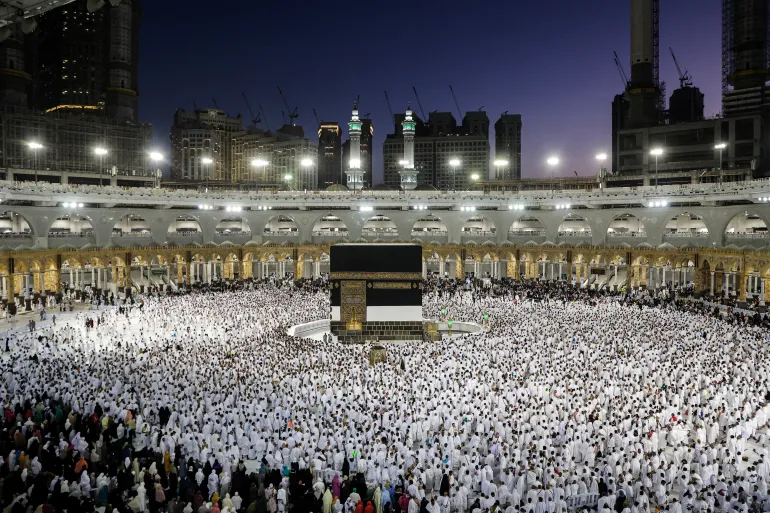
For many Muslims, Hajj is more than a journey. It is a calling that lives in the heart. For Moulana Yunus Kawanga, preparing for Hajj 1447 carries emotional, spiritual, and communal significance that stretches far beyond himself.
As a Black South African Muslim from a township background, his journey represents not only personal fulfilment, but a sense of possibility for communities that are often overlooked in conversations around global Muslim experiences.
His reflections on Hajj are a reminder that sacred journeys are not defined solely by financial means, but by sincerity, intention, and trust in Allah.
A special invitation
Unlike many South African pilgrims who register through the Nusuk platform, Moulana Yunus received a special invitation through the King in January 2024.
The invitation came as a surprise, but throughout the interview, he speaks about it with humility rather than status. He repeatedly attributes the opportunity to the duas of his parents, especially his mother, whom he describes as one of the greatest pillars in his life.
For him, this pilgrimage is deeply connected to family.
His father also performed Hajj in 2004 through an opportunity connected to his employment at the time. Years later, the son now follows a similar path. A continuation of faith passed down across generations.
Coming from a township environment where many people grow up believing certain opportunities are beyond their reach, the experience feels even more significant. Moulana Yunus acknowledges that many young people from kasi communities do not always see themselves represented in these spaces.
His journey changes that perception.
SMread: Pedaling for peace across a continent
Hajj is about more than being financially ready
One of the strongest themes throughout the discussion is the idea that Hajj is not only about financial preparation. Moulana Yunus shares a perspective that resonated deeply with listeners: “The condition is not between yourself and your pocket. It is actually between you and Allah.”
The statement reframes how many people think about the pilgrimage. While Hajj certainly requires financial and physical capability, he believes spiritual readiness matters just as much.
As a psychology student and educator specialising in life orientation, Moulana Yunus naturally links spirituality with self awareness and personal growth. He speaks passionately about understanding oneself, healing internally, and building a stronger relationship with Allah before seeking external success. Hajj is not simply a journey, but a transformation.
SMread: SAMNET warns Durban graffiti part of broader anti-Muslim campaign
Representing a minority within a minority
As a Black Muslim in South Africa, Moulana recognises the complexities that sometimes come with existing within a minority community while also challenging cultural stereotypes associated with Islam.
He hopes his journey can help reshape perceptions around what Muslim identity looks like.
Islam, he explains, is not tied to one race, language, or culture. Yet many people still hold narrow assumptions about who belongs within Muslim spaces.
His presence challenges those assumptions while creating visibility for township Muslims who may have previously felt disconnected from experiences like Hajj.
More importantly, he wants young people from underserved communities to believe that these opportunities are possible for them too.
The pilgrimage becomes symbolic of something much bigger than travel.
SMread: South Africans are not immune to Seasonal Affective Disorder
Carrying the duas of a community
Throughout the interview, Moulana Yunus repeatedly returns to the community. He speaks about carrying the hopes, prayers, and aspirations of the people around him.
His duas are not focused only on personal success. They extend toward family, youth, and the broader South African Muslim community.
He specifically highlights the challenges facing young people today, particularly unemployment and hopelessness. Referencing South Africa’s unemployment rate of 32.7%, he expresses concern for youth who are struggling to find purpose, direction, and opportunities.
His desire is simple: to be beneficial to others.
Quoting the hadith, “The best amongst you are those who are beneficial to others,” he explains that service to people is one of the most meaningful forms of worship.
SMread: South African unemployment rises to 32.7 percent
A return journey
Although Moulana Yunus previously performed Umrah in 2018, Hajj carries a completely different emotional weight. Among the places he looks forward to most is the Cave of Hira, where Prophet Muhammad (S.A.W)received the first revelation.
For most of us, the cave represents reflection, revelation, and the beginning of Islam’s message to humanity. Visiting such a site often creates a profound emotional connection to Islamic history and spirituality.
For Moulana Yunus, the experience represents an opportunity to deepen his understanding of faith while reflecting on his own journey and purpose.
Moulana Yunus Kawanga’s Hajj journey is about faith surviving limitation. It is about challenging the idea that sacred spaces only belong to certain communities, cultures, or financial classes.
It is about a young man from the township stepping into one of the most spiritually significant journeys in Islam while carrying the prayers of his family and the hopes of his community alongside him.
It is a reminder that some journeys begin long before departure. Sometimes they begin with the duas of parents. Sometimes they begin with believing that Allah can write a future far greater than the circumstances you were born into.
To hear more about Moulana’s philosophy, watch the interview below:
Image credit: Al Jazeera
