Across many formerly colonised nations, the struggle for independence ended decades ago. Yet in homes, classrooms, workplaces and even marriage conversations, colonial values continue to shape how people define intelligence, beauty, success and worth. The legacy of the empire didn’t disappear when flags changed or governments fell.
Instead, it settled into everyday life, influencing language, education, appearance and identity in ways that are often invisible to those living through them.
Political liberation removed colonial rule, but psychological liberation is a much more complicated journey.
Frantz Fanon, the Martinican psychiatrist and anti-colonial thinker, argued that colonisation was never simply about occupying land. It also occupied the mind.
In Black Skin, White Masks, he described how colonial systems encouraged the colonised to internalise the values of the coloniser, measuring themselves against standards that were never created for them, resulting in self-alienation.
Colonisation never ended when the country was freed. It stayed. It separated countries, and it separated people from themselves.
SMread: Illegal firearms fuel 99% of SA gun murders, expert warns
When someone else’s standards become your own
The effects of colonialism appear in ordinary conversations.
English is praised while indigenous languages are treated as less valuable. A degree from Europe or North America is considered to be more prestigious than one earned locally. Fair skin is marketed as beautiful while darker skin is associated with poverty or lower social status. Western accents are admired. Local knowledge is questioned. The examples are endless.
These ideas persist, and will continue to persist, because they have been repeated across generations until they began to feel natural.
Luella Nair, a BBBEE and corporate communications intern and Master’s student in educational psychology, explains that this process is learned rather than inherited. “Internalised inferiority is not something we are born with. It is learned,” she says.
She says that in countries such as India, Pakistan and Bangladesh, colonial ideals became woven into daily life long after independence. English became “a symbol of intelligence and status”, while local languages lost prestige. Fair skin was glorified and foreign education placed on a pedestal, creating the belief that local knowledge could never truly compare.
Over time, these ideas became internalised, with people beginning to judge both themselves and others according to standards established during colonial rule.
According to Nair, this creates “a painful cycle of self-rejection”, where individuals diminish their own culture, language and achievements in pursuit of external approval.
Breaking that cycle, she says, requires deliberate unlearning, greater exposure and reclaiming an identity rooted in self-acceptance rather than validation from elsewhere.
SMread: India’s cockroach movement brought down a minister. Bringing real reform will be much harder
The language of status
Language is one of the clearest examples of colonial thinking surviving independence.
For many families, speaking fluent English is seen as evidence of intelligence or higher social standing. Parents often encourage English at home, believing it offers better opportunities for their children.
While multilingualism creates valuable opportunities, problems arise when learning English comes at the expense of abandoning one’s mother tongue.
Behavioural therapist Fiona Mustafiz says this remains common across diaspora communities. Growing up in a Bangladeshi family abroad, she experienced how colonial attitudes survived migration.
She recalls that many parents prioritised English over Bangla because success in Western society seemed to depend on it. As an adult, she deliberately began relearning Bangla because she realised that “language cannot die with me”. A language celebrated for its beauty, she says, deserves to be preserved rather than replaced.
The loss of language is more than the loss of vocabulary. It can also become the loss of history, memory and belonging.
SMread: Houthi strikes on ships spark UN warning
Colour still carries power
Few colonial legacies remain as visible as colourism. Across many societies, lighter skin continues to attract compliments, assumptions of attractiveness and perceptions of higher status, while darker skin is still burdened by stereotypes.
Mustafiz says colourism has become so normalised that many people no longer notice it.
Families often comment on which parent a newborn resembles, quietly hoping the child inherited the lighter complexion. Although she is Bangladeshi, she says she is frequently told that she “doesn’t look Bangladeshi”, a statement rooted in stereotypes that assume Bengalis should have darker skin.
The reality, she explains, is that Bangladesh, like every country, contains people of many different complexions, and darker skin “most definitely doesn’t make us any inferior”.
Colonial beauty standards also continue to shape expectations within marriage, where women often face greater scrutiny over complexion, education and language than men.
Degrees that cross oceans
Education has also become part of the colonial hierarchy. An anonymous psychology graduate from Pakistan says they grew up watching foreign education being treated as the only education that truly mattered.
“My father has a Master’s degree from Pakistan, but he never used it. Instead, he applied pressure to us, urging us to ‘not be like him’, to be ‘educated’, as if his degree meant nothing because it wasn’t from a foreign country.”
They say this belief extended beyond formal education. Family members who could not speak English fluently, or who spoke with an accent, were often ridiculed, reinforcing the idea that intelligence and success were tied to Western language and institutions.
Sadly, a local qualification could be earned through years of dedication, yet still be viewed as less valuable than one obtained abroad.
SMread: Ramaphosa promises Eskom-style fix for dry taps
Liberation beyond independence
Fanon believed genuine liberation demanded more than replacing governments.
His work argued that freedom required rejecting the psychological structures left behind by colonialism. As long as people continued measuring themselves through colonial standards, political independence would remain incomplete.
When success is measured by foreign approval, when beauty is linked to whiteness, when local languages disappear from homes and classrooms, and when imported knowledge automatically outranks local expertise, colonial power continues to operate long after colonial administrations have gone.
The empire no longer governs territories, but it surely governs expectations.
Reclaiming what was lost
Undoing generations of psychological conditioning is not easy.
It starts by recognising inherited assumptions rather than accepting them as facts. It means celebrating local languages alongside global ones, valuing indigenous knowledge without dismissing international education, and rejecting beauty standards rooted in racial hierarchy.
Most importantly, it means recognising that identity is not something granted by those who once ruled. Political independence may have changed maps, but psychological independence has to force people to redefine how they see themselves.
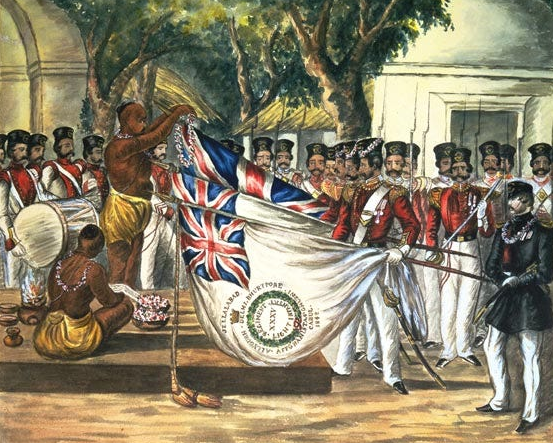
Image via Scholarly Community Encyclopedia.
