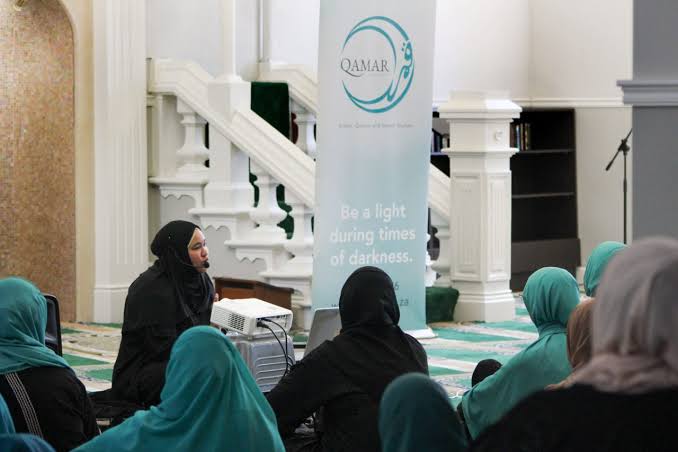
Fadwa Solomon, a South African Quran teacher and founder of the Qamar Institute, is reshaping how women around the world access the Quran. By focusing on meaning-based education, Solomon has created a learning space that is both spiritually rich and practically accessible to women from all backgrounds.
What started as a modest effort to teach tafsir to a small group of mothers has grown into an international initiative. The institute now reaches students across the globe through in-person classes, live online sessions, and recorded lessons. At its core, Qamar is built on the belief that understanding the Quran is a right, not a privilege reserved for scholars or full-time students.
The approach centres on depth rather than pace. Students are taught to explore the meanings of verses ayah by ayah, unpacking both the literal and spiritual dimensions. Classes are conducted primarily in English, and students are not required to have a background in Arabic. Instead, they learn each word’s meaning gradually, developing a connection with the Quran that extends beyond memorisation.
SMread: “Difference Between Starvation and Food”: Islamic Relief Pushes to Reach Gaza
The Launch of the Institute
The institute was originally launched under the name “For Mothers,” a reflection of Solomon’s early vision to provide accessible Islamic learning to women managing family responsibilities. The name was later changed to Qamar Institute, after the Arabic word for moon. The symbolism behind the name is intentional, like the moon, which reflects the light of the sun, women are seen as carriers of light, especially within the family. Whether full or crescent, the moon remains a source of beauty and guidance.
The structure of Qamar’s programmes is tailored to accommodate the demands of modern life. The part-time schedule is designed for working professionals, stay-at-home mothers, and students who may not be able to commit to a full-time course. Online options allow women from rural areas or international locations to benefit from the same content and community.
The emphasis on meaning also plays a crucial role in the institute’s outreach to new Muslims. Many reverts are overwhelmed by the formal structure of traditional Islamic education. Qamar offers an alternative that is welcoming, flexible, and focused on building a foundational understanding. Lessons are accessible to those with little to no Arabic, and the environment is one of encouragement rather than pressure.
SMread: South Africa’s Deepening Obesity Crisis Demands Urgent Action
The Importance of Practical Workshops
Beyond Quranic education, Solomon’s work includes community-focused initiatives such as a practical workshop series designed to help caregivers nurture Islamic values in young children. Drawing on early childhood development principles and her Montessori training, the programme teaches mothers, teachers, and babysitters how to build love for Allah in the home without relying on fear-based messaging.
Qamar Institute also brings attention to the role of both mothers and fathers in Islamic parenting. Drawing from stories in the Quran, particularly the relationship between Prophet Yusuf and his father Yaqub (A.S), the curriculum subtly reinforces the need for warmth, communication, and spiritual investment within the family unit.
The growth of Qamar has been largely organic. As more women experienced the transformative power of studying the Quran with understanding, they recommended it to others. This word-of-mouth expansion has allowed the institute to flourish with minimal marketing, relying instead on the impact it leaves in people’s lives.
For many students, the experience is deeply personal. Attending classes has led to spiritual renewal, emotional healing, and a renewed sense of identity. The act of learning becomes more than academic, it becomes a form of worship.
Solomon’s broader message to women is simple but powerful: studying the Quran is not just for the elite. It is for every woman who wants to find herself in the words of Allah, to carry His light in her home, and to pass it on to future generations. The institute continues to open doors for women who thought the path to Islamic knowledge had closed long ago.
Image via Qamar Institute’s website.
