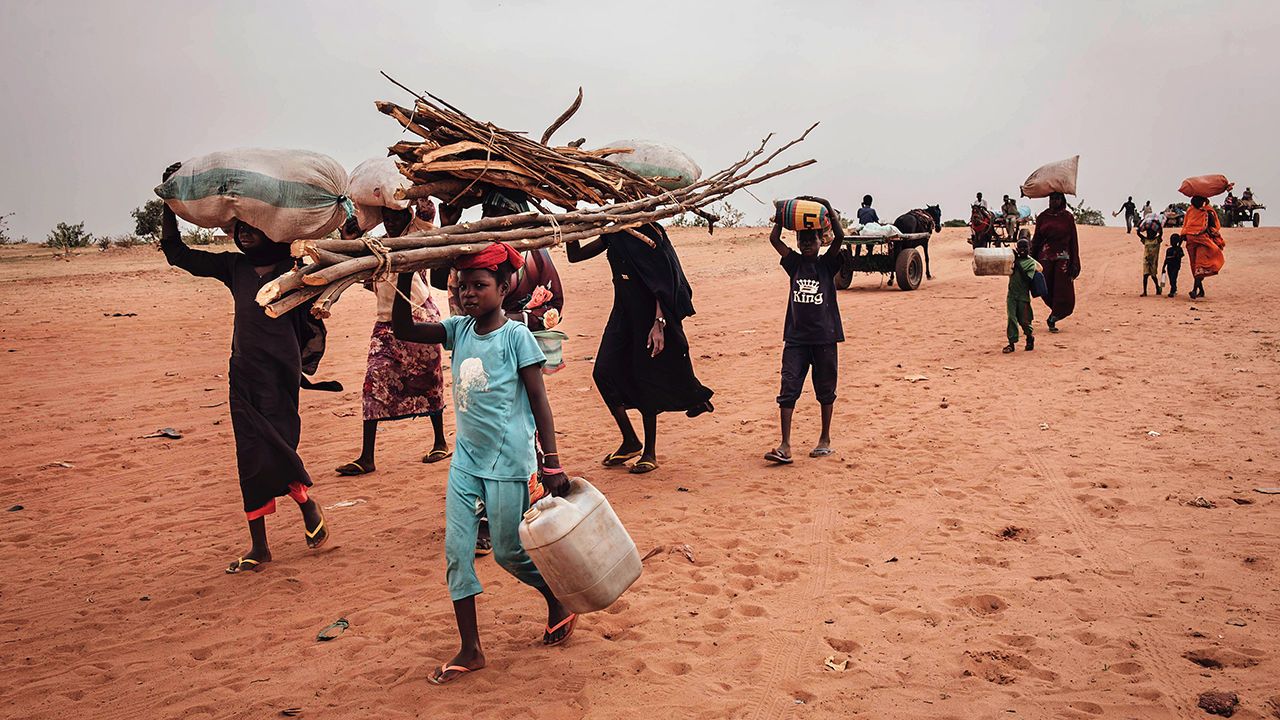
At least 40 civilians were killed and 19 others injured after heavily armed fighters from the Rapid Support Forces (RSF) stormed a displacement camp near al-Fasher, the capital of North Darfur, on Monday. The attack underscores the escalating violence against civilians in Sudan’s devastating civil war, which has now raged for over two years.
The assault occurred at the Abshuwak displacement camp, a refuge for approximately 450 000 people who have fled the ongoing conflict between the RSF and the Sudanese Armed Forces (SAF). According to Sundanese journalist Saeed Abdalla, the RSF fighters “stormed part of the Abshuwak displacement camp…attacked residents and fired their homes.”
This incident is the latest in a series of attacks on areas meant to be safe zones for civilians. The El-Fasher attack is part of a broader strategy by the RSF to besiege the city, which remains the last significant stronghold for the SAF in the Darfur region. Abdalla noted that the RSF is “besieging that city and trying just to be in control…by cutting all this food, medical supply, and all of these humanitarian needs.”
The United Nations has warned that such repeated assaults on civilian populations could amount to war crimes. The conflict, which began as a power struggle in April 2023, has created one of the world’s largest humanitarian crises.
SMread: Cyclist pedals for peace across Africa
A deepening humanitarian catastrophe
The civil war has had a catastrophic impact on the Sudanese population. Official figures, which many on the ground believe are vast underestimates, state that over 12 million people have been displaced and more than 40 000 killed. Aid agencies have warned that the country is on the brink of an unprecedented humanitarian disaster, with famine, displacement, and violence spiralling out of control.
In the besieged city of al-Fasher and its surrounding camps, the situation is particularly dire. A famine was declared in the nearby Zamzam camp over a year ago. Displaced mother Fatma Yaqoub told PBS NewsHour, “We are suffering so much from no food, no water. We are hungry… We have nothing to eat but animal feed.”
The country’s healthcare infrastructure has all but collapsed, with an estimated 80% of facilities no longer functioning, leaving millions without access to medical care amid outbreaks of cholera and malaria. The brutal El-Fasher attack serves as a grim reminder of the daily reality for those trapped by the fighting.
The conflict is characterised by intense fighting for strategic territory, with civilians caught in the crossfire or deliberately targeted. The RSF, which has its origins in the notorious Janjaweed militia, has been accused of ethnic cleansing and genocide, particularly in the Darfur region. The group has denied these charges.
As the military situation remains a stalemate, observers stress that a political solution is the only viable path forward. “There’s no military winning here, there’s no military solution for the Sudanese crisis,” Abdalla stated. “The only solution is going to be peaceful and a solution comes with negotiation and with deeper discussions for the root cause for war in Sudan.”
International diplomatic efforts continue, with the United Arab Emirates recently reaffirming its support for a peaceful resolution. However, for the millions suffering on the ground after the latest El-Fasher attack, any hope for peace seems distant as the world’s attention is largely focused elsewhere.
Image vua imago
