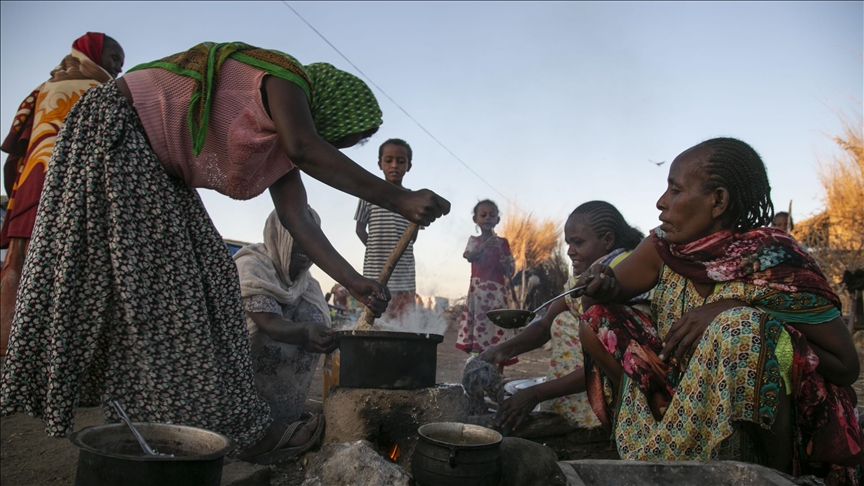
Image Source: Anadolu Ajansı
Africa – According to Geopolitical Analyst in the Horn of Africa, Edmund John, hunger is being weaponised as a tool of war in Sudan, with the country’s brutal civil war now entering its third year and showing no signs of resolution. The conflict between the Sudanese Armed Forces and the paramilitary Rapid Support Forces has devastated infrastructure, collapsed local economies, and left millions of civilians without access to food, water, or medical care.
UN agencies warn that nearly 19.5 million people, roughly two in every five Sudanese, are experiencing crisis levels of food insecurity or worse, with 135,000 already living in catastrophic conditions.
John said approximately nine million people are internally displaced, with a further four million having fled into neighbouring Uganda, Ethiopia, and Egypt. Forty per cent of health facilities are no longer functioning, 17 million people lack safe drinking water, and 24 million lack adequate sanitation.
“About 40% of the health facilities’ sanitation infrastructure has been destroyed. And then there’s just growing food insecurity as a result of continued hostilities that have occasioned the farming but also blocked access to humanitarian aid.”
Aid Corridors Deliberately Blocked
Only 20% of Sudan’s 2026 Humanitarian Needs and Response Plan had been funded by April, and aid organisations reached only 3.1 million of the 4.8 million people targeted monthly. John said the blockades were not incidental to the fighting but deliberate, with the Rapid Support Forces bearing the most responsibility for cutting off civilian lifelines.
“What we mean is the weaponisation of access to aid or the weaponisation of hunger. About 20% of truck traffic has been able to make through. So that means about 80% of the truck traffic bringing in aid has not been able to access conflict-trapped populations.”
Children Bearing the Brunt
The crisis is hitting children the hardest. An estimated 825,000 children under five are expected to suffer from severe acute malnutrition in 2026, a seven per cent increase on last year and 25 per cent above pre-conflict levels. Between January and March alone, nearly 100,000 children were admitted for treatment.
WFP Executive Director Cindy McCain warned that the threat of famine remains immediate, with aid agencies struggling to reach the communities that need assistance most. The numbers coming through treatment centres have alarmed the UN system.
“Children suffering from severe acute malnutrition arrive at overstretched facilities too weak to cry,” said UNICEF Executive Director Catherine Russell.
No Peace Deal in Sight
A high-profile conference in Berlin, backed by the United States, the European Union, and the African Union, produced financial pledges but no ceasefire. No mechanism to bring the warring parties to the table has emerged from any of the international efforts to date. WFP’s Director of Emergencies and Preparedness Ross Smith warned that the scale of the crisis was no longer deniable.
“Hunger is not only widespread, but it is deepening,” Smith said.
With neither side willing to negotiate and international pressure failing to gain traction, John warned that military incentives were overriding any prospect of a peaceful resolution.
“Both sides have not been able to sit on the table and discuss the future of Sudan and a peaceful resolution to the conflict. And as either side makes any military gains on the ground, it’s incentivised to pursue military policy even more.”
