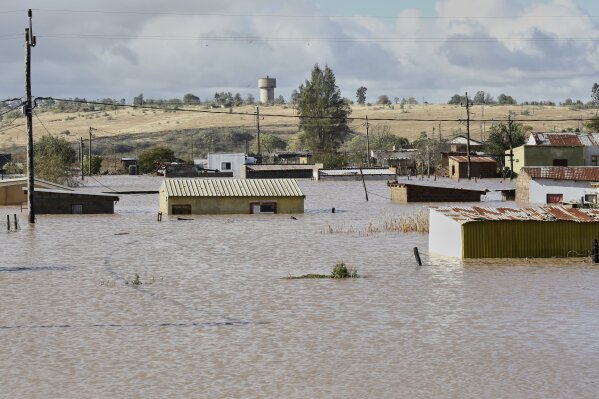
Local – More than 1,300 people remained displaced across the Eastern Cape following the devastating floods of June 2025, with hundreds still awaiting emergency housing.
The provincial government has prioritised shelter for these vulnerable individuals, but limited funding and local resistance have delayed progress.
According to Cooperative Governance and Traditional Affairs MEC Zolile Williams, 1,353 people were being housed in Mass Care Centres, and a further 122 were accommodated in Temporary Emergency Accommodation.
“Beneficiaries were issued SASSA food vouchers to alleviate immediate food insecurity. To date, more than 1,353 displaced individuals have been accommodated across Mass Care Centres and 122 in Temporary Emergency Accommodation, prioritising the most vulnerable groups, with full access to healthcare, food, sanitation, dignity packs, mattresses, blankets, and school uniforms,” he said.
Occupancy at care centres has begun to decline as some families return to partially habitable homes or stay with relatives.
However, for thousands of others, resettlement remains out of reach. The floods destroyed 4,724 homes and partially damaged another 2,145.
“More than 6,869 households across the province were affected by the disaster,” Williams confirmed.
Significant Funding Still Required
To address the housing emergency, the Eastern Cape provincial government stated that over R2.1 billion is needed, R461 million for Temporary Residential Units (TRUs) and R1.7 billion for permanent housing solutions.
“Government is working hard to address the budget shortfall, and we continue to mobilise our partners for support in this area,” Williams said.
An initial R120 million has been reprioritised through the Department of Human Settlements for the immediate rollout of TRUs. Still, current funding only covers 1,230 of the 4,724 units required.
Land has been identified in the Mnquma and King Sabata Dalindyebo (KSD) municipalities, yet implementation has been delayed due to local opposition.
“It is regrettable that the municipality has had to resort to courts of law to seek recourse,” Williams noted.
He cautioned that this resistance posed “a real threat to the timely rollout of the provincial government’s resettlement plan,” and appealed to communities to support relocation efforts.
“We must, in all that we do, ensure that families start rebuilding their lives and they do not, through our direct or indirect actions, suffer secondary trauma.”
