This article is adapted from an essay examining the South African state’s obligations under the post-apartheid social contract.
On 10 May 1994, Nelson Mandela stood before the world and made a solemn covenant with South Africans: “We shall build the society in which all South Africans, both black and white, are assured of their inalienable right to human dignity” (Mandela, 1994). Two years later, the 1996 Constitution turned that vision into law, obliging the state to progressively deliver basic socioeconomic rights — housing, healthcare, water, food, social security and education — as it worked to reverse apartheid’s deep injustices (South African Government, 1996; Ragolane, Thusi & Xhoza, 2024).
Yet, as the country inches closer to its seventh democratic municipal elections, service delivery remains patchy at best and nonexistent at worst in many communities. Decades after democracy’s dawn, the state’s inability to fulfil these constitutional promises amounts to a profound breach of the post-apartheid social contract.
SMread: Bylaws punishing the poor, activist says
The social contract and its breaking point
The social contract is the unwritten — and sometimes explicit — agreement between the state and its citizens. The state is expected to protect rights and promote wellbeing, while citizens agree to obey the law and participate in democratic processes (Okeng & Diala, 2024; Raphael, 1970). In South Africa, the Constitution elevated this contract by embedding socioeconomic rights in the Bill of Rights, charging the government with delivering them.
Public administration is the engine meant to make this happen. As Woodrow Wilson famously put it, public administration is “government in action” (Wilson, 1887). In practice, this responsibility falls heavily on local municipalities — citizens’ first and most direct point of contact with the state (Ndevu & Muller, 2017).
Successive ANC governments have made undeniable progress since 1994, dramatically expanding access to services for millions previously ignored under apartheid. But today, that momentum has stalled, and frustration is rising.
SMread: From the township to the holy cities
The inherited burden, and early reforms
When the ANC took power in 1994, it inherited a public service designed for control rather than delivery: centralised, fragmented, racially divided, and staffed heavily through apartheid-era affirmative action for Afrikaners (Posel, 1999; Cameron, 2009; Mamdani, 1996). Reforming this machinery was always going to be a monumental task.
Between 1994 and 1997, the new government introduced legislative changes, including the Public Service Act, deployed loyalists to key positions, and began the long process of transformation (Ncholo, 2000; Jeffery, 2023). The goal was clear: build a capable state that could deliver on the Reconstruction and Development Programme (RDP).
SMread: SA–Iran relations, the bargaining chip of Hormuz and the fragility of diplomacy
Shifting strategies, and persistent problems
Over the past three decades, the government has tried three broad approaches to service delivery (McLennan, 2009):
- Reconstruction through expansion (Mandela administration): massive roll-out of houses, water, electricity and social grants. Early results were impressive, with millions gaining access to basic services.
- Modernisation through markets (Mbeki administration): influenced by New Public Management ideas, the state stepped back to become a regulator while private entities took on delivery roles (e.g., Johannesburg’s Igoli 2002 programme).
- Developmental state model: a return to a more interventionist state, pursued more aggressively under Jacob Zuma and continued by Cyril Ramaphosa through initiatives like Operation Vulindlela (The Presidency & National Treasury, 2026).
Despite these shifts, success has been limited. Today, two-thirds of municipalities are in financial distress and 64 of 257 are officially dysfunctional (The Presidency & National Treasury, 2026). The Auditor-General has repeatedly raised red flags about financial mismanagement (Maluleke, 2025).
Deep-rooted issues — cadre deployment, corruption, lack of accountability, skills shortages, and brain drain — continue to cripple the public service (Cameron, 2009). Competing values of efficiency, fairness and resilience often clash, making effective delivery even harder (Hood, 1991).
SMread: Israeli forces detain activists on Gaza flotilla
Citizens’ response: protests and apathy
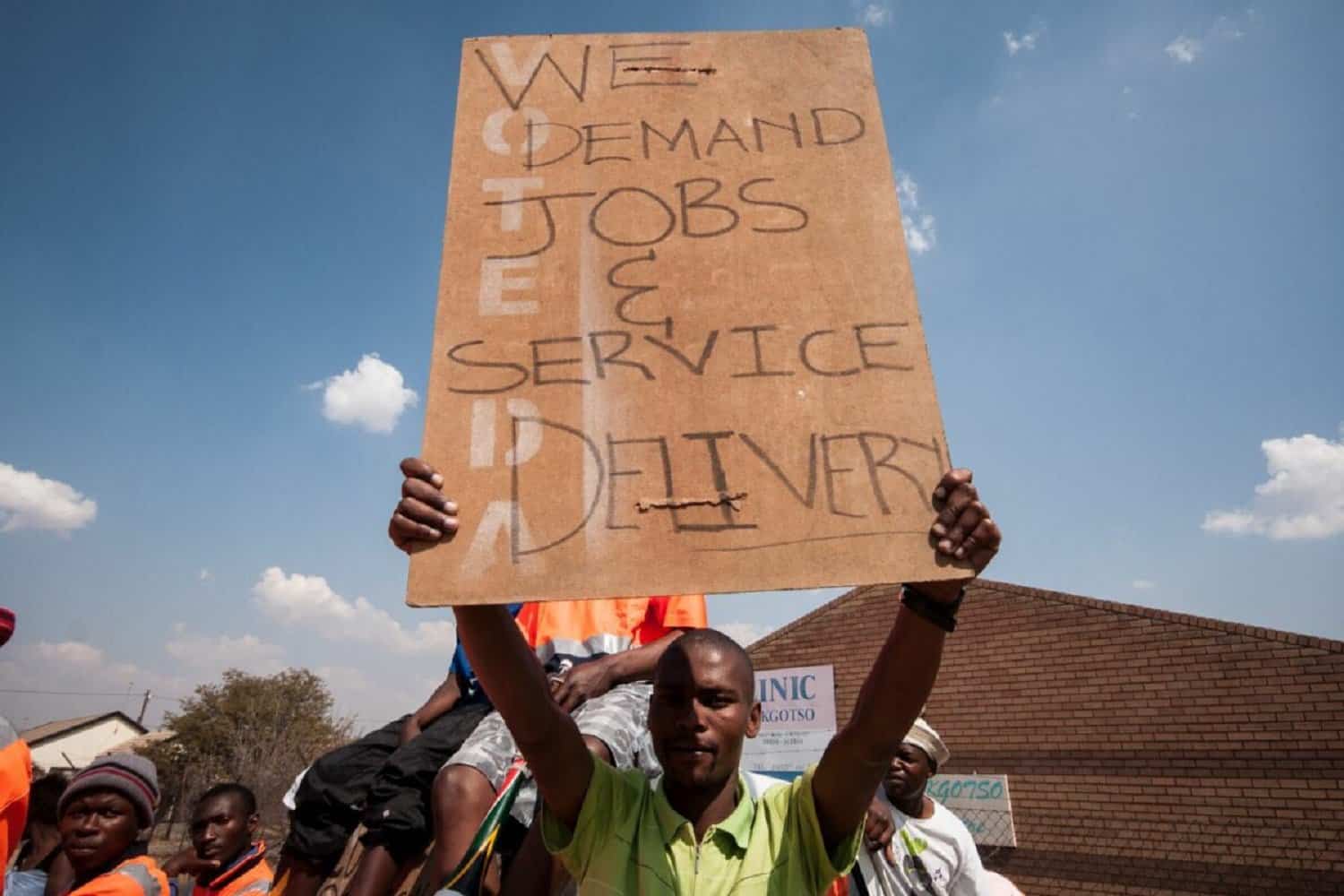
Faced with broken taps, unreliable electricity, sewage-filled streets and uncollected rubbish, many communities have taken to the streets in protest. Others have simply withdrawn — staying away from the ballot box in growing numbers. Both responses signal deep disillusionment with a social contract that feels increasingly one-sided.
As voters prepare to head to the polls, the message from the ground is clear: impressive constitutional promises and policy pivots are no longer enough. Without serious reform — including depoliticisation of the public service, better skills development, stronger accountability, and smarter use of technology — the gap between the state’s promises and its performance will continue to widen (Corrigan, 2026).
More than thirty years after Mandela’s inauguration, restoring the social contract will require far more than new strategies on paper. It demands a functioning state that can finally turn the constitutional promise of human dignity into a daily reality for all South Africans. Until then, the social contract remains dangerously frayed.
Image credit: Gallo Images / Frank Trimbos
References:
Cameron, R. (2009). New Public Management Reforms in the South African Public Service: 1999-2009.
Corrigan, T. (2026). The IRR’s Blueprint for Growth: In service of the public: Reforming South Africa’s public administration. Institute of Race Relations.
Hood, C. (1991). A Public Management For All Seasons?
Jeffery, A. (2023). Countdown to Socialism. Jonathan Ball Publishers.
Maluleke, T. (2025). CONSOLIDATED GENERAL REPORT ON LOCAL GOVERNMENT AUDIT OUTCOMES 2023-24. Auditor-General of South Africa.
Mamdani, M. (1996). Citizen and Subject: Contemporary Africa and the Legacy of Late Colonialism. Princeton University Press.
Mandela, N. (1994). President Nelson Mandela: 1994 Presidential Inauguration.
McLennan, A. (2009). The politics of service delivery. Wits University Press.
Ncholo, P. (2000). Reforming the public service in South Africa: a policy framework. Public Administration and Development.
Ndevu, Z. and Muller, K. (2017). A conceptual framework for improving service delivery at local government in South Africa. African Journal of Public Affairs.
Okeng, E. and Diala, A.C. (2024). Promotion of Service Delivery in Terms of the Social Contract Theory in South Africa’s Legal Framework. Potchefstroom Electronic Law Journal.
Posel, D. (1999). Whiteness and Power in the South African Civil Service. Journal of Southern African Studies.
Ragolane, M., Thusi, X. and Xhoza, N.G. (2024). Navigating the Promise and Perils of Post-Apartheid Service Delivery. Pakistan Journal of Life and Social Sciences.
Raphael, D.D. (1970). Problems of Political Philosophy. Praeger Publishers.
South African Government (1996). Constitution of the Republic of South Africa, 1996.
The Presidency and National Treasury (2026). Operation Vulindlela Phase II.
Wilson, W. (1887). The Study of Administration. Political Science Quarterly.
