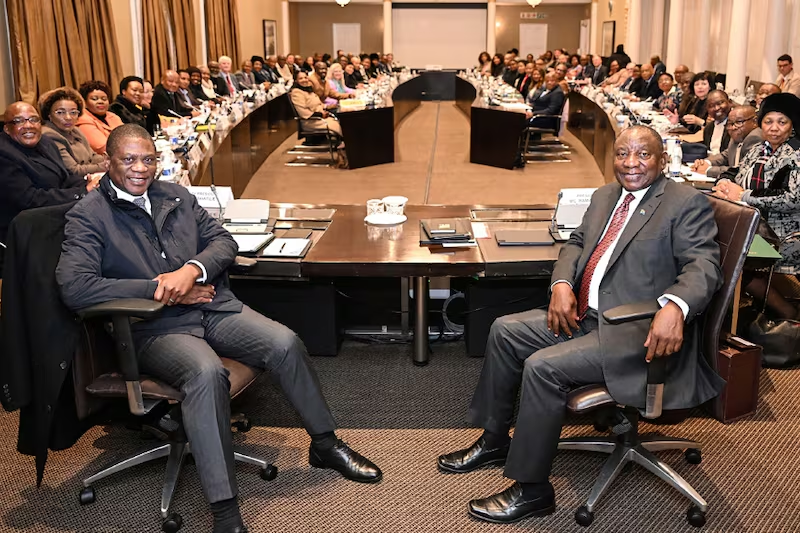
June 2024 was a historic moment in South Africa’s political history. Following watershed national election, President Cyril Ramaphosa’s African National Congress (ANC) and almost a dozen other political parties agreed to share power with former foes. Two years later, the coalition still stands.
The government of national unity (GNU), as they dubbed it, emerged from the ashes of three decades of single-party governance. The May 2024 election saw the social-democratic ANC lose its grip on power for the first time since Nelson Mandela was installed as head of state. Electoral support plunged from 57% in 2019 to a mere 40% in 2024. This made power-sharing necessary.
When it was revealed that the likes of the liberal Democratic Alliance (DA) and conservative Freedom Front Plus (FF+), ideological enemies, would enter the governing camp, a number of political commentators were incredulous. One prominent analyst gave it a six month shelf life. Two moments of tension nearly vindicated him: first, when the ANC and DA clashed over a proposed VAT hike, and then when Ramaphosa axed Andrew Whitfield. Alas, the arrangement remains intact.
There are three primary reasons why the parties to this inconvenient marriage have stuck together for better or worse. Firstly, political office opens access to a range of strategic and material benefits. For the ANC, whose machinery runs on patronage networks, access to the levers of power is an existential issue. Secondly, it offers an opportunity to influence policy. For the DA, a party that had for decades been consigned to opposition benches in Parliament, participation in national governance provided a historic opening to introduce market-led reforms in government. Finally, active governance affords a kind of visibility only incumbents enjoy.
This does not mean, however, that the incumbent administration is guaranteed to serve out its term, set to expire in 2029. Factors like internal resistance (especially within the ANC, which is preparing for a national leadership contest next year), the Phala Phala impeachment process and other external shocks could undo the fragile alliance in a blink. Time will tell.
Read next: Tafelberg triumph: Court backs affordable housing
Image via BusinessDay.
