By: Rasha Abou Jalal. This story was originally published by The New Humanitarian.
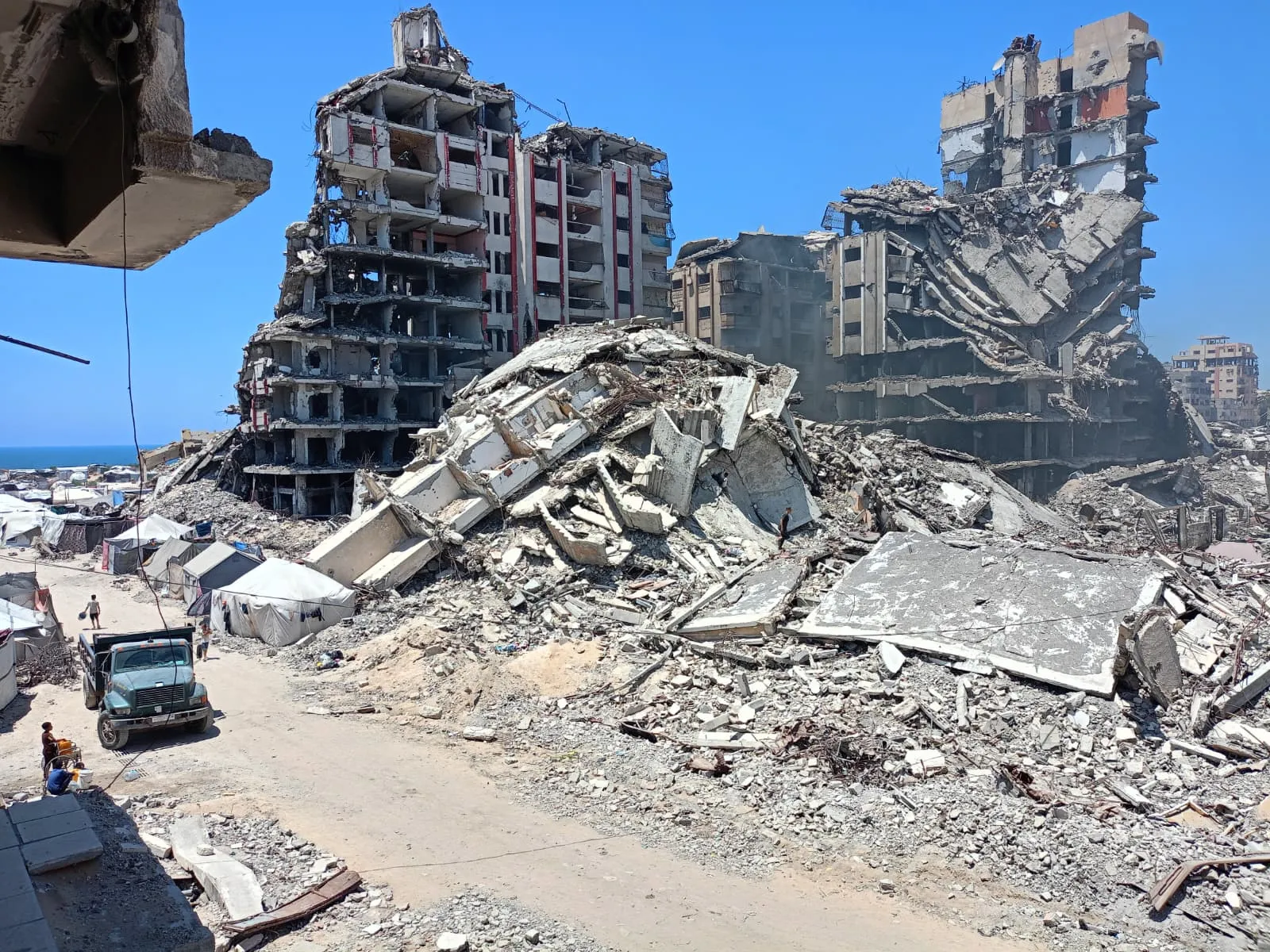
When I walk through the streets, I sometimes feel as though I am wandering inside a city that has just survived a massive earthquake. Rubble still fills the roads and destroyed buildings stand like giant skeletons bearing witness to what happened.
The war that began in October 2023 did not only destroy homes; it pushed Gaza many years backward. Electricity and internet networks collapsed, and water and sewage pipelines were severely damaged. Overall, around 80% of the infrastructure in the Strip was destroyed or damaged. But for us, the residents, these are not merely numbers. They are details we live with every single day.
Despite all of this, people here are trying to reclaim their lives. Yet every step toward recovery feels exhausting, expensive, difficult, and painfully slow. The main reason is Israel’s continued ban on the entry of many essential materials needed for reconstruction. Food and clothing are almost the only items Israel allows into Gaza. Beyond that, construction materials, spare parts, electronic devices, and everything that would help us to restore normal life remain prohibited.
Everywhere I go, I hear people speaking about waiting – waiting for reconstruction, for electricity, for water, for the crossings to open, for a future that feels vague and uncertain. Israel ties all of this to a demand that residents here see as impossible: the disarmament of Hamas, which has ruled Gaza since 2007, and continues to do so. Hamas says it won’t lay down its weapons until Israel ends its occupation of the Palestinian territories captured in 1967. We are stuck.
So the only sense of a return to normal life we get is in very small moments: a child finding a toy among the rubble, a woman managing to cook with gas after months of relying on firewood, a man succeeding in repairing a broken window using wooden pieces he gathered from a destroyed home. But even these small moments remain surrounded by fear. Everyone knows that this temporary life could collapse again at any moment if war returns once more.
SMread: The unresolved case of Dr Hussam Abu Safiya
Small moments of joy
On a personal level, there are small moments when I feel I am recovering something from my old life, or perhaps something from my humanity that the long war drained away. One of those moments happened just a few weeks ago when we finally managed to wash our clothes using an electric washing machine. This may sound ordinary to anyone living outside Gaza, but for us it was an extraordinary event.
Since the beginning of the war, we washed our clothes by hand because electricity had completely disappeared. I would sit for long hours scrubbing clothes inside plastic water containers while feeling my back and hands collapsing from exhaustion. Water was scarce, soap was rare, and the cold winter was harsh. Sometimes I washed clothes with salty water or water that was not completely clean because we simply had no other choice.
The clothes themselves carried the smell of war: smoke and must from the humidity and burning fire wood. No matter how much we washed them, they never truly smelled clean.
But a few weeks ago, we finally managed to install several solar panels on the roof of a neighbouring damaged house. The panels were old and used because Israel also prohibits new solar panels from entering Gaza. Prices have soared. Before the war, one panel cost no more than $250. Today, the price has reached $4,500.
That morning, I placed the clothes inside a washing machine that we had pulled out from beneath the rubble of our destroyed home. I felt strangely nervous, fearing the electricity would suddenly cut off, or that I would discover the machine no longer worked.
My daughter Saida, 13 years old, stood beside me watching. “Mama… will it really work?” she asked. I smiled and said, “I hope so.”
When the machine finally started spinning, Saida gasped loudly and ran to call her siblings. She shouted excitedly, “Come quickly! The washing machine is working!”
My children gathered around it as though they were watching something magical. They stared at the movement of the clothes and water behind the glass door with genuine joy. Saida laughed and said, “I had forgotten the sound of the washing machine.”
She sat on the floor in front of it and kept watching for long minutes. After a while, she looked at me and said, “You know, Mama? I used to feel like the war was inside our clothes.” I asked her, “How?” She replied, “Whenever I wore my clothes, I smelled tents, smoke, and fire. Even when we washed them by hand, they never smelled nice.”
When the washing was done, she picked up one of the clean pieces of clothing, hugged it to her chest, and inhaled deeply. In a low voice, she said, “This is the first time since the war that I smell clothes that smell like life.”
I felt a sharp ache in my chest. How could a 13-year-old girl associate the idea of life itself with the smell of clean clothes? But the war in Gaza has forced us to redefine everything. Cleanliness is no longer something ordinary. Electricity is no longer a normal service. Even running a washing machine has become a family event worth celebrating.
After we finished hanging the clothes under the sun, Saida sat beside me and asked, “Mama, do you think our lives will ever return to how they were?”
I did not know how to answer and remained silent. Then Saida continued, “Sometimes I feel like we are alive again, and sometimes I feel like the war is still here.”
She was absolutely right.
SMread: Could AI create a new form of inequality in South Africa?
No real progress
Despite the many months that have passed since the ceasefire, what hurts people most here is the absence of any real progress in rebuilding Gaza.
Everywhere, tents still fill the streets, open spaces, and empty lands. Some tents have torn apart completely and can barely remain standing. Last winter, water leaked into the tents during every rainstorm, while the ground turned into thick mud that clung to feet, clothes, and blankets. In summer, the tents become suffocating ovens.
With no clear horizon for reconstruction, some people have begun rebelling against tent life in their own way. I have seen families building tiny shelters from wood, nylon sheets, and old zinc panels. These are not real homes but desperate attempts to obtain something resembling stability.
Even building these simple rooms has become extremely expensive. Wood is now very scarce and, of course, prohibited from entering the Strip. It is sold by weight because of the limited supply. One kilo costs around nine shekels (about $3), a very high price for most Gaza families who have lost their sources of income.
One resident, a father of four called Mohammed Mushtaha, invited me to visit the tiny room he was building for his family among olive trees beside his destroyed home.
The room consisted of wooden boards, a roof made from nylon and zinc sheets, and an old door pulled from a destroyed house. Pointing towards the room, he told me, “I am not building a house. I am only trying to escape life in a tent.”
I asked him whether the room was safe. He smiled sadly and replied, “Nothing is safe in Gaza, but at least my children can sleep here without the wind tearing the tent above their heads.”
SMread: Iran denies tanker attacks as US hits over 80 targets in retaliation
Searching for alternatives
Daily life in Gaza has completely changed because of the war. People here have become experts at searching for alternatives. Almost everything has become scarce, missing, or unbearably expensive, forcing us to reinvent the details of our everyday lives.
Electricity usually comes through solar energy or small generators. Many people charge their phones for money at small shops. Some families limit electricity use to certain hours in order to conserve power.
Water remains one of the greatest crises. Many families depend on buying water from mobile tankers, while others are forced to use salty or unclean water.
Even cooking has changed entirely. During the war, women learned to cook using firewood and even plastic – despite its danger to human health – after cooking gas disappeared for long periods. Even now, many families still rely on these methods to prepare food.
In the markets, life feels strange and confusing. Some goods are widely available, such as chocolate, chips, and soft drinks, while essential items like vegetables, fruits, rice, and sugar are extremely scarce and expensive. You may find imported chocolate, yet fail to find a small battery or a spare part for a water pump.
What I understand from this Israeli policy is that Israel is trying to avoid repeating the catastrophe of starving Gaza’s population to prevent further damage to its image in the world. At the same time, it seems determined not to allow Gazans to restore normal life, perhaps in an attempt to push them toward emigration abroad.
Entirely new professions have also appeared. Some people make household tools from rubble, while others recycle metal, plastic, and wood. Even brooms are now handmade from palm branches because basic products are scarce.
One day, I saw a man sitting in front of his tent making a broom from dried palm sticks. He told me, “In Gaza, we can no longer wait for things. If they disappear, we make alternatives ourselves.”
SMread: YUSUF DINDAR: We have to start asking serious questions about FIFA
Fears of war returning
Despite all these attempts to reclaim life, Gaza has not known real peace even for a single day since the ceasefire. Israeli bombardment has not completely stopped. Instead, it has turned into scattered but continuous attacks that keep residents trapped in constant fear.
On many nights, we still wake up to the sounds of explosions or gunfire, while news of new deaths spreads almost daily. Over 1,000 people have been killed since the ceasefire came into effect, and thousands more have been injured.
For Gaza’s residents, the ceasefire feels like nothing more than a fragile and temporary truce because death is still present and fear continues to dominate every aspect of daily life. The greatest fear is the possibility of the return of a broader war.
On June 10, the Israeli newspaper Haaretz quoted Israeli security sources saying that Israeli army Chief of Staff Eyal Zamir had approved operational plans discussing the possibility of renewing military operations in Gaza because Hamas has rebuilt its military and organisational capabilities and continues to reject disarmament.
Because of these fears, residents are behaving with genuine anxiety. Many women are currently selling their gold jewelry and depositing the money in banks, fearing another displacement that could lead to the loss or theft of their gold.
One woman named Abeer Khaled, 37, told me, “During the last war, I was fleeing while hiding my gold inside my clothes. I was afraid I would die or be robbed.”
She added, “This time I want something lighter and easier. Money in the bank may be safer than gold.”
Fear here affects not only emotions, but also economic and social decisions.
Many residents who used to live in northern Gaza before the war still remain in the south despite the ceasefire. Some are afraid to return north because they believe the war may resume and that northern Gaza would once again become the first area subjected to displacement.
My brother is one of those residents still living in southern Gaza. He told me, “I do not want to relive displacement again. I am exhausted from gathering my children and running with them under bombardment.”
Even those who have returned to Gaza City often keep their tents and displacement bags ready for any emergency.
SMread: Humanitarian response ramps up as thousands pass through Musina
No future here
At the same time, more and more young people feel that Gaza is no longer a place where a future can be built. I met a young man named Mohannad al-Absi, 22, who is preparing to travel to Ireland through a scholarship programme.
I asked him, “Are you happy to travel?” He smiled hesitantly and replied, “I do not know whether it is happiness or escape.” Then he added, “We are not leaving because we hate Gaza. We are leaving because we no longer see a clear life here.”
He said Israel will allow him to travel through Kerem Shalom crossing, even though it is a commercial crossing intended for goods. I asked him, “Do you think this is part of the voluntary migration policy Israel has been talking about?” He replied, “Israel wants Gaza’s younger generations to leave permanently and does not want Gaza rebuilt.”
Al-Absi said he feels guilty for leaving while his family and friends remain behind. “Every time I look at my mother, I feel like I am leaving part of myself behind,” he added.
I asked whether he planned to return after finishing his studies. He smiled sadly and said, “I want to return, but will there still be a Gaza for me to return to?”
Collective fear
Even Gaza’s real estate market now reflects the collective fear of war returning. Prices of apartments still suitable for living have risen dramatically because they are so rare, despite the fact that many people are afraid to buy them.
A few days ago, I met a man trying to sell his apartment in Gaza City. We climbed to the third floor using a staircase that was partially cracked. The apartment was one of the few that had survived the bombardment relatively intact.
As he opened the door, the man told me, “Before the war, this apartment was worth only $40,000. Today I am asking for $70,000.”
I asked in astonishment, “How did the price rise despite all this destruction?” He answered, “Because livable apartments have become extremely rare.”
The apartment was simple and partially damaged, but merely having a roof and stable walls made it an extremely valuable commodity in Gaza today. The man said, “People are willing to pay any amount just to secure shelter.”
Yet, at the same time, he admitted that many buyers back away at the last moment because of fear. “Everyone who comes to see the apartment asks me the same question: What if the war returns?” he said. “Some people tell me, ‘Why should we pay all this money if the apartment could be destroyed again within months?’”
I asked him whether he himself thought this way. He laughed bitterly and replied, “Of course. Sometimes I think I am crazy for selling, and other times I think I am crazy for not leaving Gaza entirely.”
When I asked him how property sales are currently conducted, he began explaining the legal complications. “Many deals are now conducted informally or through written agreements between people without completing the normal legal procedures,” he said. “Government offices are not fully functioning, and some people cannot even access registration offices.”
“Some families lost their ownership documents under the bombardment, while others still keep digital copies or old paperwork,” he continued. “Even evaluating the property itself has become a problem. Some destroyed areas may later undergo urban reorganisation, and some lands may no longer be suitable for construction as they once were.”
Before I left, the man stood beside the apartment window looking at the destroyed buildings surrounding us. In a low voice, he said, “In Gaza today, even buying a house no longer means stability. Everything here is temporary… homes, plans, and even dreams.”
SMread: Tafelberg triumph: Court backs affordable housing
People continue resisting
On my way back, I kept thinking about his words.
Gaza today is not only a destroyed city. It is a city whose residents live inside a constant state of anxiety and waiting. We try to reclaim our lives and celebrate the smallest details, like running a washing machine or building a tiny wooden room, while at the same time fearing that we may lose everything again.
And yet, people here continue resisting in their own way. They resist by washing their children’s clothes, building rooms from wood, searching for alternatives for everything, and trying to convince themselves that the future is still possible.
Perhaps this is the one thing the war has not managed to destroy completely: people’s endless desire to live.
Edited by Eric Reidy.
Image: A photo taken from the apartment where Rasha Abou Jalal is living with her family, showing the extent of the destruction in her residential neighbourhood. Credit: Rasha Abou Jalal/TNH
