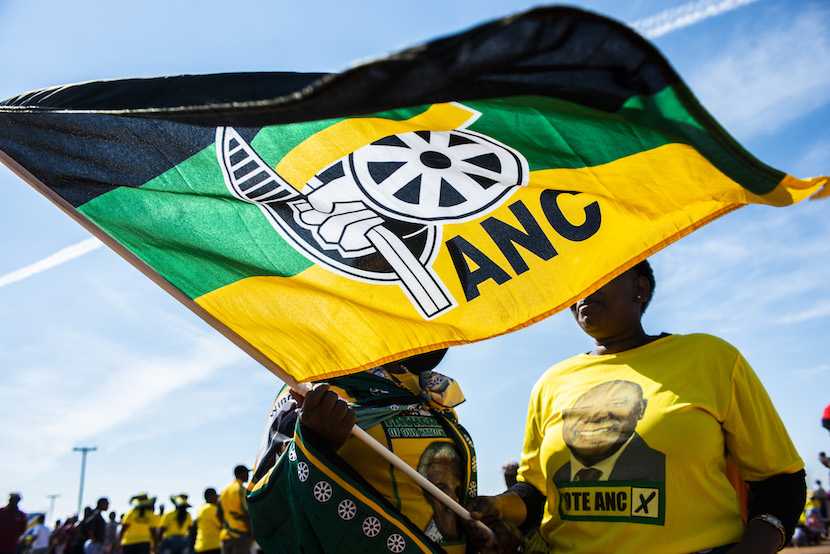
There is less than a year to go before the term of the current government will expire. This means national and provincial elections are around the corner; the silly season is brewing. Who comes in next is anyone’s guess, but it looks like 2024 might hold much drama.
For the first time since 1994, the possibility of a coalition government at a national level is really on the table. Nelson Mandela may have constructed a Government of National Unity (GNU) with former foes then, but next year is a whole other story altogether. Cyril Ramaphosa’s African National Congress (ANC) is about to face a strong reckoning.
“Corruption is largely the main factor that contributes to the implosion of liberation movements. The romance of liberation is wearing out …” said Dr Imraan Buccus, Senior research associate at the Auwal Socio-Economic Research Institute (ASRI).
Opinion polls and surveys have sprayed the writing on the wall: The ANC might not harness enough votes to reign supreme from the Union Buildings. But with a political landscape as fragmented as South Africa’s, the possibilities of coalition arrangements are manifold.
SMread: Eskom executive implicated in sabotage scandal
Liberation dividends
Liberation dividends – the idea that people would continue to vote for the ANC because they brought us liberation, as Buccus put it – are wearing out. This places the country in an interesting position as it heads towards the 30th anniversary of democracy.
“That aura starts to wear out and people care less about the gallant contributions you’ve made to liberation, but start to focus more on the real issues – the potholes being fixed, traffic lights working and having water and electricity,” he said.
This dissatisfaction amongst the electorate is becoming increasingly evident. A March 2023 poll by the Social Research Foundation placed ANC support as low as 45.9% – slightly short of the majority needed to control the National Assembly. This means coalitions are a serious possibility.
SMread: Tackling township misconceptions about Islam in Emdeni
Lack of coalition experience
The problem is that South Africa has very little (albeit chaotic) experience with coalition governance. Numerous coalition arrangements have been constructed and dismantled at a local level, at a huge cost to service delivery.
However, the only experience the country has with coalition governance at a national level would be Mandela’s GNU and, at a provincial level, an ANC-Inkatha Freedom Party (IFP) coalition in KwaZulu-Natal during that same period.
“We don’t have experience of coalitions in South Africa, or, I venture to say, many parts of southern Africa. We are not Sweden, Denmark or Germany, where coalitions are very much a part of political existence. Our limited experience at local and provincial government also has been dismal,” said Buccus.
A highly possible coalition in 2024, said Buccus, could be one between the ANC and the Economic Freedom Fighters (EFF). This would allow the ANC to retain power beyond 2024, but could cost the party lofty positions in government, depending on the red berets’ demands.
“If the ANC comes to the 40% mark, it can very easily get into a coalition with the EFF and reinforce its power. We’ve started seeing moves already in Gauteng, where the leadership is indicating its willingness to gravitate closer to the EFF.”
On the other hand, a coalition large enough between the opposition parties could push the ANC to the periphery. The Democratic Alliance’s proposed ‘moon pact’ coalition could provide an alternative, but it has the odds stacked up against it.
“If one looks closely,” explained Buccus, “numerically what he’s [John Steenhuisen] suggesting does not make sense. The Democratic [Alliance] gets little over 20% and the next party is the EFF which is not part of that coalition. One can’t imagine how that coalition is really going to get rid of the ANC.”
Coalitions may very well dominate the future. One cannot predict how it will unfold, but there are multiple possibilities for what the coalition government is going to look like in 2024, he said.
