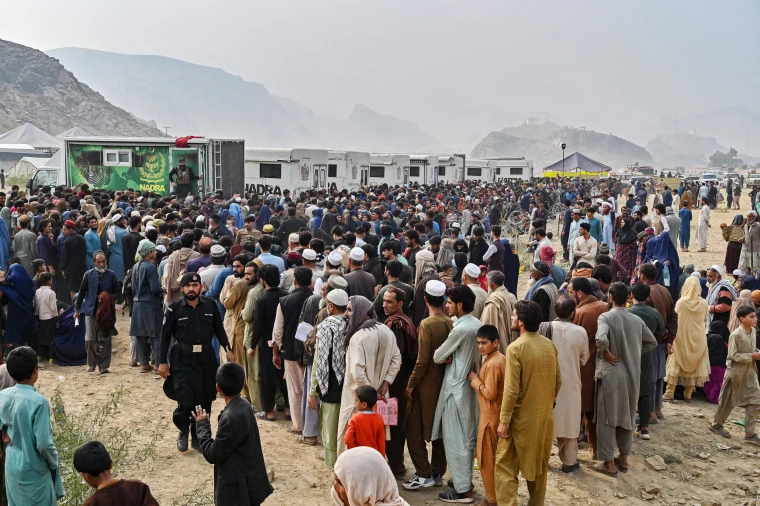
Photo by [NBC]
Afghanistan – Early last month, the Pakistan government declared that all Afghan migrants and refugees without proper documentation must depart Pakistan, either voluntarily or forcibly. This move was reportedly prompted by the increasing incidence of violent attacks in Pakistan, suspected to be carried out by Afghan individuals residing in the country.
The Pakistan government set the deadline for this action on October 31, a timeframe which observers consider insufficient for Afghan residents who have made Pakistan their home for many years to prepare for their departure effectively. As a result, the subsequent actions taken by Pakistani authorities have been deeply distressing.
Ubaidullah Safi, a representative of the International Association of Afghanistan Professionals, criticised the Pakistan government and authorities for their inhumane handling of the situation.
He noted, they have subjected Afghans to physical and verbal abuse, forcibly entered and demolished their residences, seized their possessions, and unlawfully detained them. Safi further pointed out these actions not only contravene international humanitarian laws but also counter Islamic principles.
“In a nutshell, one can say, and it will be appropriate to say, that there exist some similarities between the treatment of Afghan refugees at the hands of Pakistan army and police and that of our Palestinian brothers and sisters by the Zionist occupiers.”
SMread| Gov. introduces resource pool in response to natural disasters
Mass Afghan Exodus
Before the deportation decree, there were an estimated 1.7 million undocumented Afghan individuals in Pakistan. Meaning there was already a substantial population of Afghan nationals who had been residing in the country for decades, establishing their lives, families, and businesses.
Furthermore, these migrants have made valuable contributions to various sectors within Pakistan. However, the influx of Afghan migrants into the country saw a significant rise, reaching hundreds of thousands, after the Taliban regained power some years ago.
Safi said some individuals born into these Afghan families in Pakistan have never experienced their ancestral homeland, viewing Afghanistan as an unfamiliar and foreign place. While he had always anticipated a time when Afghans living in Pakistan would need to return home, he did not foresee it would occur in such a manner, especially given the shared history and belief system between the two nations.
Safi expected a more compassionate approach and an extended timeframe to enable Afghans to sort out their affairs and depart in a peaceful, organised, and dignified manner.
“Surely, by any norms and standards, they deserve to be afforded ample time and opportunity to wind up their businesses, sell their properties and transfer their wealth to Afghanistan. But unfortunately, the interim government of Pakistan or, to put it more appropriately, the military establishment unilaterally, suddenly and unfairly decided to forcefully send millions of Afghan refugees home within a short period.”
Safi stated the Afghan government, in collaboration with international NGOs, has established arrangements to welcome their citizens upon arrival at the border. Considering the fragile and desperate conditions that Afghanistan has faced in recent years, this deportation may exacerbate the country’s challenges and endanger the lives of its people.
