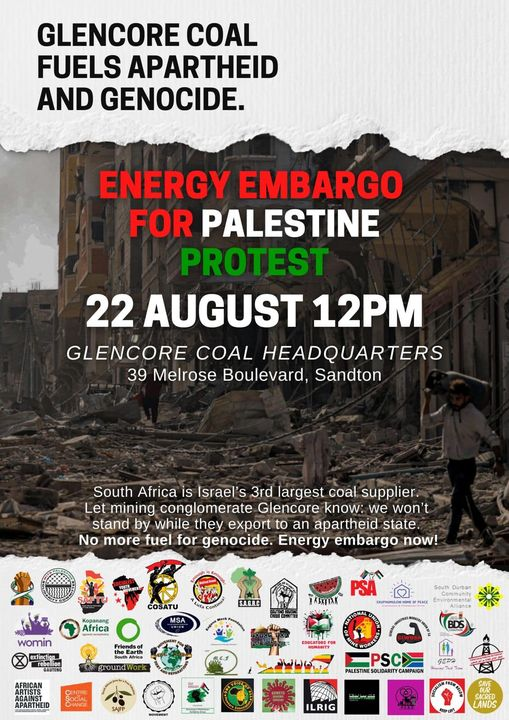
South Africa – The South African Coalition for Boycotts, Divestments, and Sanctions (BDS) along with other Palestinian solidarity groups organised a series of protests today at Glencore’s headquarters in Johannesburg and simultaneously at its subsidiary, Astron, in Cape Town. These demonstrations are part of a more considerable effort to pressure Glencore, a significant player in the global coal industry, to discontinue its coal exports to Israel.
According to Roshan Dadoo, Coordinator at the BDS Movement, protesters and Palestinian solidarity groups argue that the coal trade between Glencore SA and Israel directly supports the genocide in Gaza and the occupation of Palestinian territories.
She claimed that South Africa’s coal exports, among others, contribute to Israel’s electricity grid, which in turn supports Israel’s military actions and the oppression of Palestinians by controlling electricity in Gaza, the West Bank, and East Jerusalem. This, she argues, makes Glencore complicit in Israeli crimes against the Palestinian population.
“The Israeli power grid depends on coal, and 22% of its output depends on coal, which is pretty huge. If we could manage to stop South Africa also selling coal, as well as Colombia, we would really be making a big impact and a big dent on the capacity of Israel to function and to carry on the genocidal war and the illegal occupation.”
“The electricity goes into one central grid, so you cannot argue that your coal is not part of this, that your coal is somehow not having anything to do with the illegal settlements, which gets more power than the Palestinians. As we know, Palestinian villages and towns in the West Bank get their power cut, and they have to pay Israel for that power that comes from this grid that South African coal is supplying.”
“So our message to Glenore is, stop fueling genocide. Come and tell us clearly that you are going to stop coal sales to Israel from your mines.”
SMread| Youmna El-Sayed speaks of ‘hell’ in Gaza
South Africa Are Legally Obligated to Cease Any Connections to Israel
Since the beginning of Israel’s war in Gaza and their decades-long occupation of the Palestinian people, South Africa has been one of the few countries to consistently oppose Israel’s actions and violations of international and humanitarian laws.
Our commitment to this cause is so strong that we have aligned our values and freedoms with those of the Palestinians, asserting that we will never be truly free until they are.
As a nation, we have upheld this principle by leading the charge against Israel, even taking them to the International Court of Justice for the genocide and ongoing crimes in Gaza. However, it is troubling that South Africa is also one of the largest coal suppliers to Israel.
This contradiction raises concerns among Palestinian supporters and groups about South Africa’s potential complicity in the very actions it condemns globally, primarily through companies like Glencore.
Dadoo stated that it is crucial we do not appear hypocritical by condemning Israel’s ethnic cleansing on the global stage while simultaneously supporting them through our economic activities.
She emphasised that the South African government and companies must act consistently with the nation’s values by ceasing all exports to Israel, thereby ensuring that the country is not complicit in fueling the ongoing genocide. They are obligated to do this by the ICJ’s ruling.
“Colombia was the largest exporter of coal to Israel, so we really welcome the announcement by the President that he intends to stop coal exports. And now, it actually comes into force today with a declaration from the government stating that they will, with effect from today, 22nd August, be stopping all coal sales to Israel. So, if Colombia can do that, and it has a significant amount of trade in coal with Israel, then it’s totally possible for South Africa to do it too.”
“Also, corporations need to take note that they are obliged under international law—not only the ICJ cases but also business and human rights laws—that they are required to follow, particularly in situations of armed conflict. Additional international humanitarian and criminal law standards apply to corporations and, importantly, to individual business leaders. They really need to consider whether their operations are contributing to gross human rights violations.”
