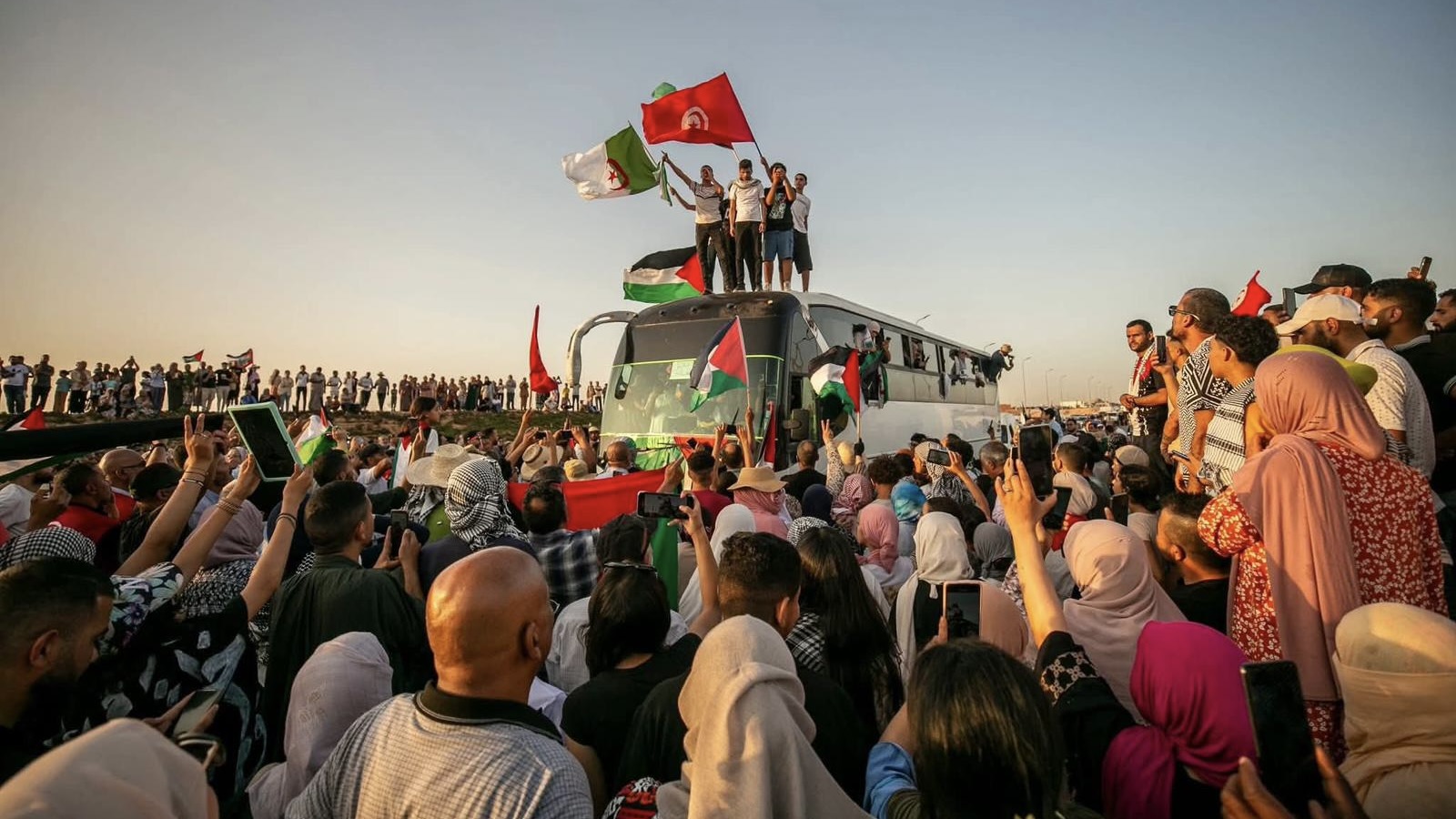
Dozens of international activists, including sitting MPs from South Africa, Ireland and Turkey, were violently obstructed by Egyptian authorities while attempting to reach the Rafah crossing as part of the Global March to Gaza. The convoy, which sought to break the siege on Gaza and deliver a message of international solidarity, ended in arrests, deportations and physical assaults, raising urgent concerns about Egypt’s role in suppressing humanitarian action.
They came with flags, prayers and peaceful protest. But by the time the sun set, the road to Rafah had turned violent. What began as a humanitarian mission ended in beatings, intimidation and broken spirits. Yet the resolve of those who marched remains intact.
SMread: Belal Khaled Arrives in SA for Palestine Solidarity Tour
Why They Marched
For UK-based activist Heike Boulet, the decision to join was deeply personal. “Palestine has been part of my heart for over a decade,” she said. “The genocide has been going on for 76 years and counting at minimum.”
Boulet, who discovered the convoy through Middle East Eye, self-funded her travel. For her and hundreds of others, this was not just a march. It was a lifeline. “We had to do something and get those borders open… Gaza is starving, experiencing famine, dying every day.”
Danielle Pauline Camba, currently based in the Emirates, added that despite the restrictions on political expression where she lives, silence was no longer an option.
“We cannot just sit in our home… we need to act,” she said. “This is the only time that we can contribute as humans to help the people of Gaza who are dying every day.”
The convoy was a mix of faiths and nationalities. Muslims, Christians, Hindus and others united under one flag: freedom for Palestine.
SMread: Palestinian Journalists Battling Two Wars
Blocked at Every Turn
The warm welcome many expected from Egypt never came. Instead, they were met with suspicion, hostility and eventually, violence. “It was hostile from the get-go,” said Boulet. “Egypt wasn’t expecting us, but they let us in only to restrict movement.” Checkpoints became trapdoors. At Ismailia, the convoy staged a peaceful sit-in after being blocked for hours. “We started doing chants, flying Palestinian flags… but as the sun set, the authorities prepared to forcibly remove us.”
That night, Egyptian men in civilian clothing, allegedly paid enforcers, attacked. “They started throwing bottles, dragging people by force,” Danielle recalled. “I was dragged by the foot, laid on the ground, whipped on my back.”
Activists tried to shield each other. Boulet and others physically intervened, placing their bodies between the aggressors and the most vulnerable. Still, the Egyptian authorities looked on. Despite the brutality, Danielle remained grounded. “We are not using violence. We are peacefully raising our message.”
Both women were candid in their disappointment with Arab leaders. But they made a clear distinction between government and citizens. “The majority of [the Egyptian people] are totally on the side of the Palestinians,” said Boulet. “They consider Palestinians their brothers and sisters.”
Her anger was not limited to Arab regimes.
“Our governments are supporting the genocide, financing and weaponising it. We shouldn’t have to be doing this; our governments should.” Danielle echoed this sense of global failure, but with unwavering faith in the people.
SMread: UNICEF: Over 5,000 Gaza Children Treated for Malnutrition in May
The Fight Is Not Over
The activists never reached Rafah, but they believe their efforts were far from futile. They view the march as a powerful act of raising awareness, reigniting global conversations about Gaza, and exposing the aggressive tactics used by Egyptian authorities. For many, the shared struggle fostered deep bonds among participants, turning strangers into lifelong allies.
For more on this, find the conversation below:
Image: Tunisians depart on Gaza convoy. Credit: Tunisia Land Convoy
