Palestinian journalists are fighting a battle on two fronts: one against physical violence in Gaza and another against digital suppression online, according to photojournalist Belal Khaled. Speaking at the Nelson Mandela Foundation in Johannesburg, Khaled described a deliberate “social media war” aimed at silencing Palestinian voices and concealing the realities of the conflict.
Khaled, who is currently touring South Africa, accused major technology companies of actively working to stifle content from the region. “Meta and Facebook and Instagram, they always doing a war against all the content coming from Palestine,” he stated. “Any content also related to Gaza, to the genocide, they hide it, they restrict your account, they deleted our account.” He claimed this suppression is a calculated effort to prevent global audiences from witnessing the events unfolding on the ground, alleging that these platforms are “controlled by occupation, by the Zionists.”
This digital battle, according to Khaled, runs parallel to the unprecedented physical dangers faced by his colleagues. The conflict has become the deadliest on record for journalists, with the Committee to Protect Journalists (CPJ) confirming that at least 185 media workers have been killed since the genocidal war began. The vast majority, 177, are Palestinian. This grim statistic underscores the severe risks involved in reporting from Gaza and the immense pressure on what Khaled terms a “social media war.”
The Human Cost of Covering the Conflict
For journalists like Khaled, the professional duty to document events is intertwined with profound personal loss. He described the emotional burden of reporting on a community to which he is deeply connected. “We have two eyes,” Khaled shared. “One eye is covering and one eye is crying… Because all of the people there, we know them. We live with them, they are our relatives, our friends, our colleagues, and also our people.”
This testimony sheds light on the immense psychological toll of the conflict. Khaled’s assertion that this is “the first genocide going live” highlights the unique role of journalists and citizen reporters in broadcasting the conflict in real-time, even as they face what he describes as a systematic “social media war” designed to obscure their work.
International rights groups have corroborated the dangers on the ground. Reporters Without Borders (RSF) has filed complaints with the International Criminal Court, accusing the Israeli army of deliberately targeting journalists. The Israeli military has admitted to assassinating several journalists it claims were militants, but organisations like the CPJ and Al Jazeera have dismissed these allegations as “unfounded.” The UN has also criticised Israel for spreading “disinformation” about journalists’ affiliations without providing evidence, further complicating the environment for those attempting to report truthfully from the conflict zone.
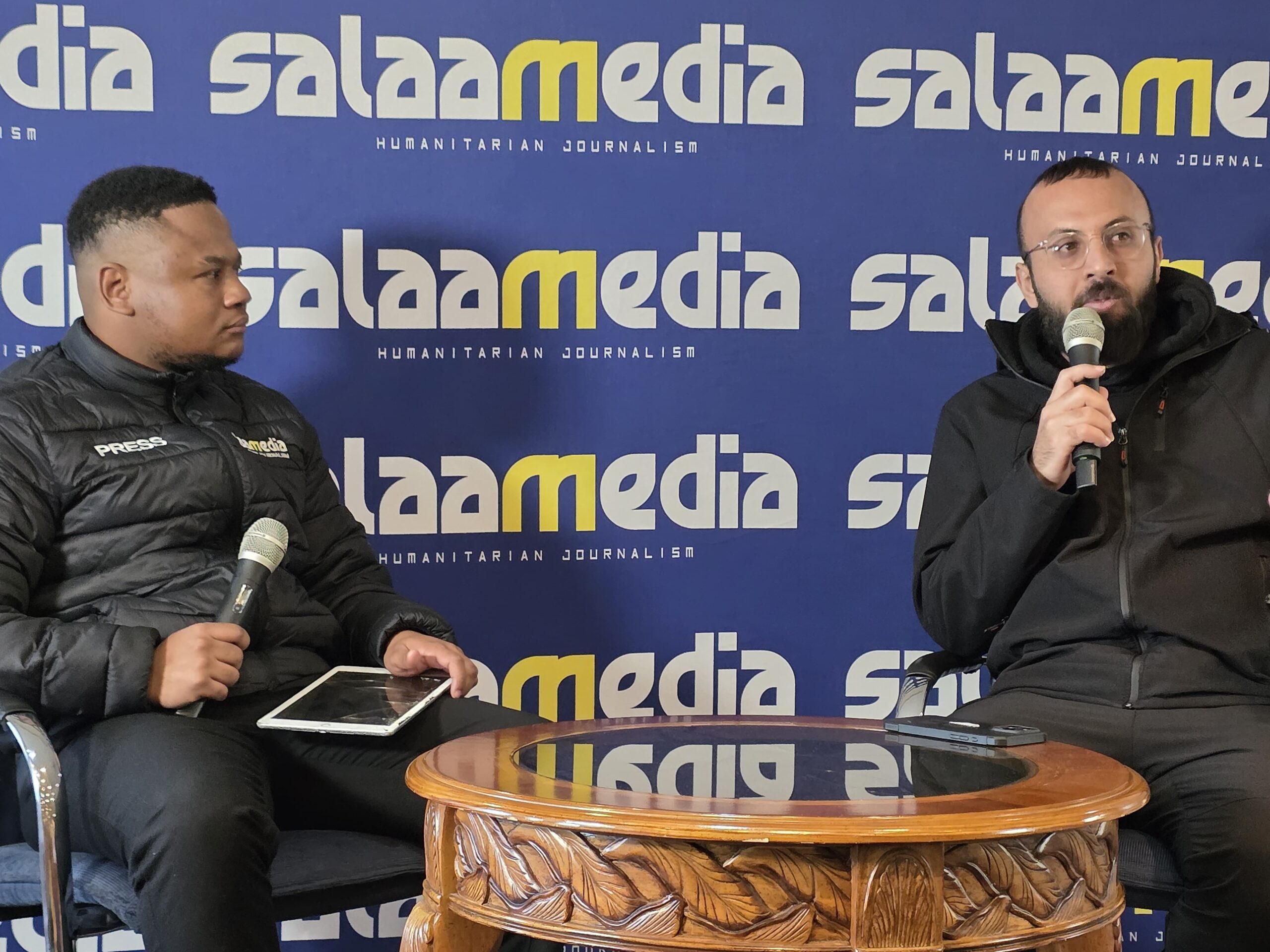
Image: Belal Khaled (right) in conversation with Salaamedia’s Selaelo Makhwidiri (left) on Friday. Credit: Nasreen Naidoo/Salaamedia
