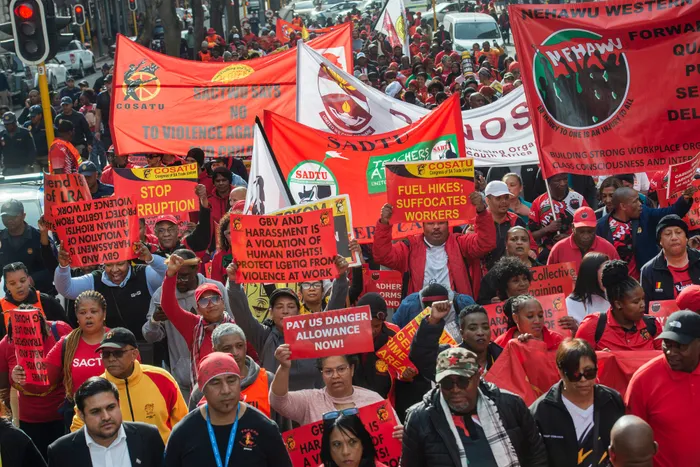
Labour analyst and attorney, Patrick Deale, has weighed in on the debate around South Africa’s unemployment crisis after the KwaNazi police commissioner accused unions of demanding excessive wages that prevent job creation. In his view, pointing fingers at unions oversimplifies the issue and distracts from the real problems holding back growth.
Unions are not the main cause
Deale argues that unions are fulfilling their role within collective bargaining, representing workers in negotiations over fair wages. To lay the blame for mass unemployment at their feet ignores deeper structural problems in the economy. He stresses that unions are legitimate actors, not scapegoats.
“The comments were misplaced in the sense that the context in which they were made was the wrong context,” he said, referring to the commissioner’s statement. “Unions are there to defend their workers and to pay what they consider to be a fair wage and for employers to agree or not agree.”
Instead of blaming organised labour, Deale points to the stagnant economy. He describes South Africa’s shrinking economic base as a cake that is not growing fast enough to feed the growing population. “The overall problem that we have in the labor market is the lack of growth because if you have a cake you can only share it among so many people,” he explained.
SMread: Abeer Zayyad: Defending Palestinian heritage
Growth, investment and reform are key
For Deale, sustainable job creation can only happen if South Africa attracts both local and international investment. A stable regulatory environment, efficient governance and an end to corruption would help build confidence and trigger growth.
Privatisation is part of the solution, he argues, pointing to Transnet as an example. “Privatization creates competition. Competition brings prices down and it creates efficiencies to maximize the proper use of facilities, the proper delivery of services.”
He also acknowledges that artificial intelligence will reshape the labour market by replacing routine and semi-skilled jobs. While this is a challenge, he believes AI can also create opportunities if workers are supported in reskilling and adaptation.
On taxation, Deale recognises that AI has helped close loopholes and improve collection efficiency. But he warns that corruption undermines progress, as revenues are not always translated into meaningful development.
South Africa’s unemployment crisis, he concludes, cannot be solved with simple answers or misplaced blame. What is needed is a broad set of reforms: governance improvements, a business-friendly investment climate, privatisation where appropriate, and skills development to prepare workers for the future.
For more on this, watch the video below:
Image: Armand Hough /Independent Newspapers
