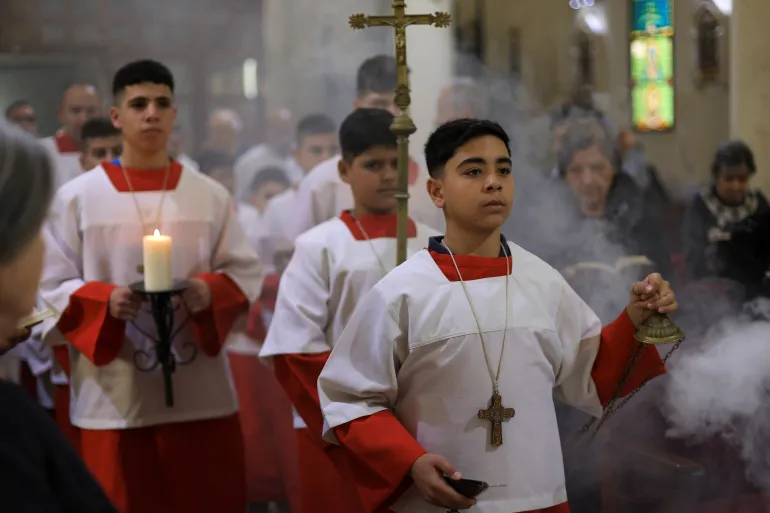
Image Source: Al Jazeera
Occupied Palestine – As Christians around the world celebrate Easter, Palestinian Christians, the oldest Christian community in the world, continue to be oppressed by the Israeli regime, facing escalating settler violence, forced displacement, and increasing restrictions on religious freedom in the West Bank.
The plight of Palestinian Christians rarely features prominently in mainstream narratives around the occupation, yet their communities are being systematically eroded. Senior researcher at UWC’s Desmond Tutu Centre for Religion and Social Justice, Thandi Gamedze, said acknowledging their presence disrupts a carefully constructed narrative.
“Palestinian Christians are the oldest Christian community. This is where the Christian faith was born. And yet often they are written out of the story in various ways because I think acknowledging the presence of Palestinian Christians throws a spanner into the Zionist propaganda and what they often use to win support.”
Not a Religious Conflict
Gamedze emphasised that the oppression Palestinian Christians faced was rooted in their nationality, not their faith. Ancient communities in Beit Sahour and the village of Taibeh were being encircled by expanding Israeli settlements, with new construction threatening to physically divide these towns and restrict Palestinian movement through increased checkpoints.
The situation was deteriorating. Even prominent religious figures had not been spared, with a Catholic cardinal recently denied entry to the Church of the Holy Sepulchre, one of Christianity’s most sacred sites, during the Easter period.
“If that’s the case for this very important figure in the church, how much more is it a case for the average Palestinian Christian who is trying to get into those spaces?”
South African churches had largely failed to meet the moment, Gamedze argued. Christian Zionism had taken hold across racial lines, while Israel had run a deliberate campaign of flying select church leaders to the country to shape their views. Gamedze invoked the spirit of the 1985 Kairos Document, warning that silence was not neutrality.
“If they don’t take a stance, they’re taking the stance of the oppressor.”
