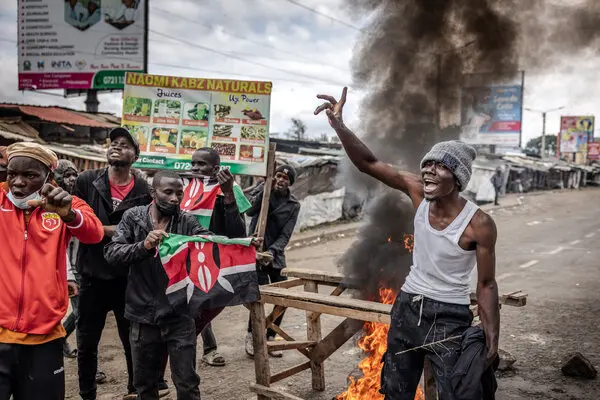
At least 31 people have been killed and more than 500 arrested in Kenya following nationwide anti-government protests that have seen a new generation of young activists demanding systemic accountability. The demonstrations, initially sparked by the death of a blogger in police custody, have escalated into a broader movement against a “broken system” plagued by economic hardship and police impunity.
The protests coincided with the 35th anniversary of “Saba Saba” (Seven Seven in Swahili), a day historically marking Kenya’s struggle for multi-party democracy. However, this year’s marches have been defined by a youth-led charge for deeper societal reforms.
“Basically what young people are calling for is accountability, the rule of law, and also economic emancipation,” Muchesia Anyika, a Nairobi-based Development and Leadership Consultant, told Salaamedia. He explained that while the right to peaceful demonstration is protected under the Kenyan Constitution, the state has responded with “a lot of brute force through the police.”
The situation intensified following the death of 31-year-old blogger Albert Ojwang in police custody in June. His death, which President William Ruto called “heart-breaking and unacceptable,” became a catalyst for renewed public anger. The protests have since spread across at least 20 of Kenya’s 47 counties.
President Ruto has taken a firm stance, ordering police to shoot protesters targeting businesses in the legs to incapacitate them. In a public address, he defended the police actions and warned that any attempt to change the government through “unconstitutional means” would not be tolerated.
However, human rights organisations have condemned the state’s response. A joint statement from groups including Amnesty International Kenya and the Law Society of Kenya criticised the use of lethal force, the deployment of heavily armed police in unmarked vehicles, and the denial of citizens’ rights to assembly. The United Nations has also expressed deep concern over the use of “lethal ammunition” against protesters.
SMread: UK’s Palestine Action Ban Sparks Condemnation
A Generational Struggle for a New Kenya
Analysts and activists argue that the protests are not merely about a single leader but are a symptom of deep-rooted systemic failures. The core grievances fuelling the demonstrations are economic and social despair, particularly among the educated but unemployed youth.
“Most of the issues that young people or the issues that are causing the demonstrations are just triggers to the bigger problem, which is more of an economical problem and a social problem,” Anyika stated.
He described the situation as a “generational struggle,” with a highly educated and energetic youth population facing a bleak future. “I have friends who have even master’s level degrees, but they don’t have jobs. So that generational struggle, it’s like a time bomb.”
Despite the violent crackdown, the protesters’ resolve appears unshaken. Many young Kenyans express a desperate willingness to sacrifice for a better future. “We’ve reached a place where young people are saying that if it’s about dying for my country, then it’s OK,” Anyika noted.
The movement’s ultimate goal is the “rebirth of Kenya,” characterised by a renewed social contract and a government that serves its people. The call for accountability extends from junior police officers to the highest levels of command. As Anyika concluded, the youth are hopeful for “a dream Kenya where education is free, a dream Kenya where the rule of law applies to everybody equally.”
Image: Protestors at a barricade in Nairobi, Kenya, on Monday. [Luis Tato/AFP/Getty Images]
