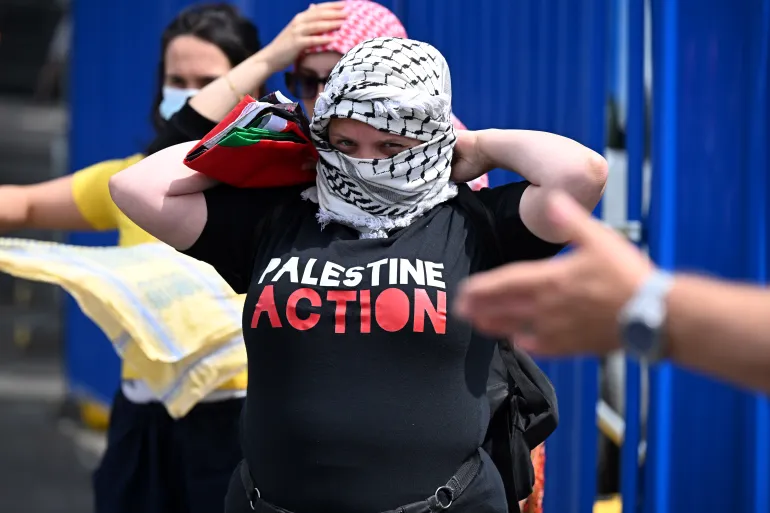
In a move that has sent ripples across the UK’s pro-Palestine solidarity movement, the British government has officially banned the activist group Palestine Action. The proscription, which took effect on 5 July 2025, places the group in the same legal category as organisations like ISIS and Al-Qaeda, making it a serious criminal offence to support or be a member of the group.
The decision by Home Secretary Yvette Cooper followed an incident in June 2025 where activists from the organisation broke into RAF Brize Norton, an air force base in Oxfordshire, and sprayed red paint on two military planes reportedly used for surveillance missions over Gaza. The government argued that the group’s activities, which have consistently involved direct action and property damage against companies linked to Israel’s arms industry, met the threshold for terrorism under the UK’s Terrorism Act 2000.
However, the ban has been met with immediate and forceful opposition. On the day the proscription came into force, police arrested 29 people, including an 83-year-old priest, at a protest outside the Houses of Parliament in London for showing support for the now-banned group.
Anas Mustapha, a lawyer and Head of Public Advocacy at CAGE, described the scene as “absurd” and “totally dystopian,” highlighting that pensioners and elderly individuals were among those arrested.
SMread: Vigilante Groups Block Healthcare, Sparking Crisis
A Chilling Effect on Free Speech?
Critics argue that the proscription represents a significant expansion of counter-terrorism legislation to target non-violent, albeit disruptive, political protest. Under the ban, expressing support for Palestine Action, wearing clothing that suggests membership, or arranging events can lead to a prison sentence of up to 14 years.
In an interview with Salaamedia, Mustapha explained the severity of the situation: “Mere support for an organisation that’s been proscribed can result potentially up to 14 years imprisonment in the most severe cases.” He contends the decision is “highly politicised,” aimed at protecting “Israeli assets and weapons infrastructure here in the UK” following years of lobbying by pro-Israel groups and arms manufacturers.
This view is echoed by numerous human rights organisations. Amnesty International labelled the ban an “unprecedented legal overreach,” while experts from the United Nations Human Rights Council criticised the “unjustified labelling of a political protest movement as ‘terrorist’.”
Nour Haidar, a barrister, wrote for the UK Constitutional Law Association that the move “lowers the threshold of seriousness that needs to be crossed before the state can legally ban all manner of disruptive political protest.”
Palestine Action, founded in 2020, describes is a movement seeking to end complicity with the Israeli regime. Its tactics have exclusively targeted property, primarily facilities belonging to Elbit Systems, an Israeli-based military technology company with a significant presence in the UK.
Despite the government’s crackdown, Mustapha believes the solidarity movement will persist. “I don’t think this is going to have a chilling effect,” he stated, suggesting it has “awakened people to the reality that if you’re campaigning for Palestine, there needs to be people who must be willing to sacrifice.” He noted that while the ban on one organisation is a serious blow, “you can’t necessarily ban people taking direct action.”
