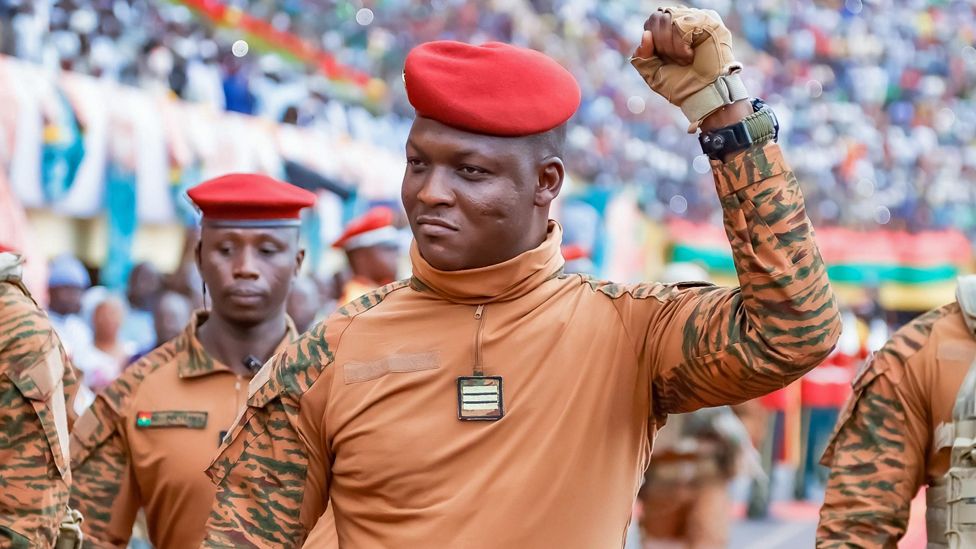
In Burkina Faso, democracy has died. Last week, President Ibrahim Traoré rejected the suitability of a government by the people and for the people in his country, telling them to “forget about it”.
“We’re not even talking about elections, first of all … People need to forget about the question of democracy … We must tell the truth, democracy isn’t for us,” he stated in an interview with state broadcaster Radiodiffusion Télévision du Burkina (RTB) on 2 April.
Traoré seized power in coup in September 2022. Despite initially pledging to revive democracy in the landlocked West African country by July 2024, he extended his term and then banned political parties.
Democrats the world over are alarmed by the world-wide erosion of their preferred model of governance. According to the latest Democracy Report, prepared by the V-Dem Institute at the University of Gothenburg, Sweden, nearly a quarter of the world is veering towards autocracy. Burkina Faso, categorised as “not free” by Freedom House, is not the only nation heading in that direction — even the beacon of democracy, the United States of America, has become less democratic since Donald Trump’s return to the White House in 2025.
Longstanding critics of democracy, however, are taking a ghoulish interest in its reversal. To them, this marks the moment when democracy finds a long-awaited reckoning.
Professor Mthunzi Mdwaba, CEO of TZoro Global Advisory, is one such individual.
“It is a concept that I believe in Africa and many developing countries has proved very unwieldy. In the first place, it was imposed on us by Western forces who built it for us and who don’t … abide and comply by the very principles that are supposed to be the building blocks of a democracy. So for me I’m not concerned at all by what he says,” he said in an interview with Salaamedia this week.
Indeed, it was the perceived failures Roch Kaboré’s democratic government that prompted Lt. Col. Damiba, Traore’s predecessor, to lay his hands on the reins. He seized power in a coup in 2022.
After banning political parties in January, effectively outlawing formal political contestation, Traore now promises to build a new system. Instead of electing representatives, a divisive process in his books, he wants to place traditional authorities at the helm.
Mdwaba and those suspicious of democracy’s practicality in Africa nod in agreement. “Africa is waking up. There is an awakening, an appreciation that we need to come up with our own concepts,” he said.
SMread: Communities infiltrated as Cape Town sells off land
Image credit: Ibrahim Traoré/X
