
The tiny house movement has gained popularity in recent years. [Picture: Devon van Deventer/Container Home SA]
In the summer of 1845, Henry David Thoreau escaped into the woods to spend the next two years alone. He set up camp on the shore of Walden Pond, where he built a cabin and lived with less for the duration of his stay.
In a remarkable autobiographical account of the experience, Thoreau explained his decision to settle in a forest in Massachustes thus, “I went to the woods because I wished to live deliberately, to front only the essential facts of life, and see if I could not learn what it had to teach, and not, when I came to die, discover that I had not lived”.
Thereau’s experiment is often cited as the inspiration behind the emerging tiny houses movement. The architectural and social movement has its roots in America during the Great Depression and advocates for downsized and simplified living spaces.
Had he been alive today, the American philosopher would have doubtless been happy to know that an increasing number of people, intrigued by the minimalist lifestyle amid bursting consumerism, are drawn to live with less.
We caught up with Deon van Deventer, a founder of one of the companies now at the forefront of this cultural shift. We wanted to know what you can get in a tiny house and whether or not, after all, less is more in living spaces in an age of excess threatened by the soaring cost of living.
Container Home SA was founded in Cape Town in 2019, when van Deventer returned from an overseas trip. He had seen the model in the United States and returned to South Africa to set up shop.
“I put a Facebook page together and within two weeks I had 5 000 likes and I thought, ‘this is a business’, so I closed my own business and started this one,” he said. Today, he believes it has become mainstream.
SMread: It’s up to us to reduce our carbon footprint
What is a tiny house?

“The moment you walk in, you actually think that you’re in a normal house. It’s not like a site office where the walls are metal and everything is just rough and ready,” said van Deventer.
Operating Container Home SA, Deon is all too familiar with the initial look of horror on the faces of prospective clients on hearing about the prospects of calling a metal box “home”.
“The perception of the market that it is a shipping container made out of steel and I’m going to live in a tin box … That whole perspective I had to change. It’s actually a normal house.”
As he explained, people often come around to the idea when they learn more about it.
A 12m container can be converted into a tiny house, covering a floor space of approximately 30 sqm. Though the small house movement is satisfied with anything smaller than 93 sqm, the tiny house movement limits the size to 37 sqm.
The shotgun shack, a small, narrow single-story building, was common amongst urban blacks in the United States during the latter part of the 19th century. They are considered to be the precursor to the Tiny House, which was developed by several people later on as part of the tiny house movement.
SMread: Fordsburg residents enter ninth week without water
Unique appeal

What makes the tiny house unique, other than the appeal of living contentedly with less, is that it can be quick to set up and easy to go off-grid. There are also the eco-conscious and economic considerations that have fuelled the tiny house movement.
“The uniqueness is that it’s inside a shipping container,” said van Deventer. “It’s reused, it’s a green technology, where most of the stuff that we use is either recycled or can be recycled. The insulation provided makes the house insulated better than your normal brickhouse, so your heating and cooling bills are much less.”
Tiny houses are especially appealing to the South African market, where unpredictability of water and electricity supply have become a source of frustration.
“Everything we do is geared towards creating a green building. We go totally off-grid. Power is solar or wind, sewage is either composting or septic tanks, the water can be off-grid. It’s a green building,” he said.
Six weeks is all it takes to convert a shipping container into a humble abode.
“Everything inside is what’s inside a normal house. What you would pay for a kitchen inside a brick building, you pay for a kitchen in a container building. You pay for flooring inside a brick building, you pay for flooring inside a container building. It’s just so much faster.”
Misconceptions
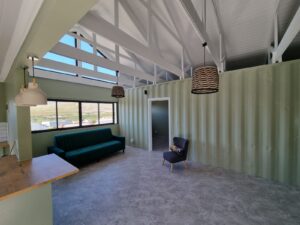
A common misconception, van Deventer noted, was that houses made from shipping containers might be too hot in summer and too cold in winter.
“Totally wrong,: he retorted. “We insulate the living crap out of it and we’ve got to comply with regulations with regards to conductivity, the amount of windows et cetera.”
But the biggest misconception, it is easy and cheap to build a tiny house from a shipping container. “It’s not easy; not by a long shot, especially getting these things through the planning regulations with the local municipalities,” he said.
He said tiny houses from shipping containers were only about 30% cheaper than traditional housing. This was because the houses were fitted with all the usual stuff you can expect in a normal house, just quicker.
These misconceptions also lead to reluctance from local authorities who at first deem it would ruin the aesthetic of the area.
Can I build with shipping containers?’ he asks them.
“The eyes go wide and they say no. Then you’ve got to convince them that this is how it looks like, this is what is done, all the regulations are followed. Then they say, ‘Okay, maybe’.”
SMread: Preparing for Ramadan physically and spiritually
Regulations
Tiny houses, whether built from shipping containers or traditional material, are also subject to the same laws and processes as any other construction project.
“We have to do everything,: he said. “Whatever you have to do for a normal house, we’ve got to do it. There are instances where I need to put tea rooms into a factory,” in which case, he said, there was no planning required.
When asked if he came across any resistance from authorities when submitting plans for tiny houses, van Deventer snapped, “Lots and lots and lots and lots and lots and lots”.
‘’When we submit the plans, the building inspector actually says to us, face-to-face, ‘There is no way in Hell I will ever allow a container home in my town’. Then it’s a process.”
Van Deventer said this was merely a knee-jerk reaction as there were no laws prohibiting such projects. He said inspectors often feared shipping containers would spoil their neighbourhood’s look.
While tiny houses may face obstacles in South Africa and elsewhere, they certainly are becoming mainstream as the world experiences unprecedented cultural shifts in the 21st century. Beyond just aesthetics and the maxim of ‘less is more’, tiny houses are also increasingly being considered by local governments to address homelessness.
Whatever the reasons for the shift and no matter the initial hurdles, Container Home SA is at the forefront of the tiny house movement, said van Deventer.
