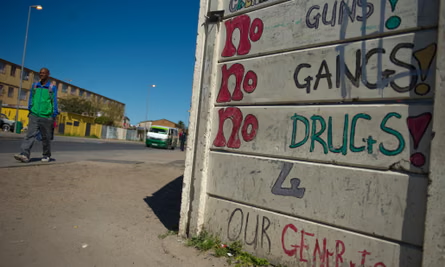
In the Cape Flats, chairperson of the Cape Flats Safety Forum Abie Isaacs is raising alarm about the growing recruitment of children into gangs, some as young as five years old, driven by poverty, family instability and state failure, in a crisis that continues to deepen amid weak coordination between government bodies and limited long-term intervention.
Gangsterism in the Cape Flats is often shown as a policing issue. But the truth is that by the time a child is holding a weapon or running errands for a gang, the system has already failed them several times over.
The first point of entry is the home. Children are being raised in environments shaped by economic pressure, absent caregivers and, in many cases, parents who were never taught how to parent themselves.
Teenage pregnancy without support structures or education feeds directly into this cycle. The result is not just neglect, but vulnerability that gangs know how to exploit. Recruitment at age five is not shocking when seen through this view.
SMread: Communities infiltrated as Cape Town sells off land
The state’s response
The responsibility isn’t just of one institution. The Department of Social Development, meant to act as the first line of defence, is described as underperforming. Interventions are inconsistent. Social workers are overstretched or absent. Families that require early support are left to navigate crises alone.
At the same time, policing and military deployment continue to dominate the response. The presence of the South African National Defence Force may stabilise hotspots temporarily, but it doesn’t change the conditions that produce crime. It contains the symptom without treating the cause.
Local, provincial and national governments don’t operate as a single system. Communication breaks down. Strategies exist on paper, including the National Development Plan 2030 and the “whole of government” approach, but implementation is uneven and, in many areas, even ineffective.
SMread: Palestinian Christians under siege as easter marks season of oppression
When unemployment becomes a pipeline
Unemployment is not just an economic issue here. It is a recruitment tool. Young people, including those with education, face limited opportunities. The gap between qualification and employment creates frustration, and in that gap, gangs offer income, identity and belonging.
Short-term job creation programmes do little to interrupt this. They provide temporary relief, not stability. Without sustained economic pathways, the cycle continues, feeding directly back into gangsterism.
Security without social repair
The current approach leans heavily on enforcement. Police operations, intelligence efforts and military presence are necessary, but insufficient on their own. Crime prevention cannot succeed without a social fix. An effective response requires coordination between law enforcement and an expanded social infrastructure.
This includes a significant increase in social workers, targeted parenting support, early childhood interventions and better intelligence coordination to prevent gang expansion across areas.
Without this integration, interventions will remain reactive.
SMread: A reckoning for democracy in West Africa?
What a meaningful response would look like
A sustainable solution is not a single programme or department. It is a system that works in alignment. That means early intervention at household level, not only crisis response. It means equipping parents, not only punishing children. It means creating jobs that last, not programmes that expire. And it means political leadership that prioritises coordination over fragmentation.
The crisis in the Cape Flats is often described as violence spiralling out of control. In reality, it is something more contained and more concerning. It is a system producing exactly what it has been trained to produce.
Interested in knowing more? Find the full conversation below:
Image via The Guardian.
