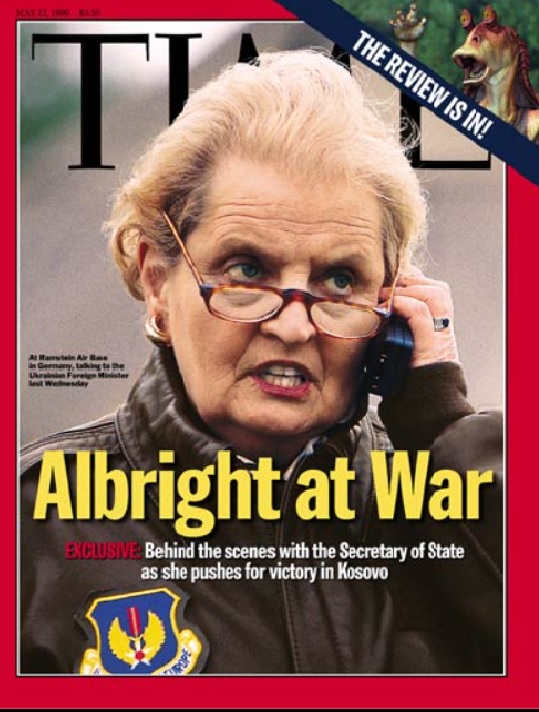
The former US Secretary of State admitted during a 60 Minutes interview that the deaths of half a million Iraqi children were “worth it” Photo – Time
Johannesburg – Madeleine Albright, the first female U.S. Secretary of State, passed away from cancer at the age of eighty-four. While the United States mourns her loss, there are many who do not share those sentiments.
Albright was born in Communist Czechoslovakia, with her family immigrating to the United States in 1948, when she was little. Her parents converted from Judaism to Catholicism in 1941 to avoid anti-Jewish persecution before they immigrated to the US.
Albright took up the post of US Secretary of State in 1997 under the Clinton administration, with resistance, having split the top tiers of the Clinton administration into two camps on selecting the new foreign policy.
Jon Schwarz, a journalist, and writer for The Intercept, tweeted, “Some people remember Madeleine Albright said in 1996 it was ‘worth it’ for sanctions to kill 500,000 Iraqi children. No one remembers the sanctions were legally supposed to be lifted when Iraq had no WMD, which, of course, it didn’t.”
His comment is backed by Gregg Zoroya, a former war correspondent, who was in Iraq during the invasion. Speaking to USA Today in 2019, Zoroya confirmed that no WMDs were found in Iraq.
“When the war started and I was with the American forces, they had maps with bunkers marked on them where they thought the weapons would be or thought they would find them but of course none were found. Later they did find remnants of chemical weapons from the Iraq-Iran war that had been made prior to 1991 and were basically useless.”
One of her biggest regrets was the Rwandan genocide which occurred between 7 April and 15 July 1994 during the Rwandan Civil War. In these 100 days, around 500 000 to 800 000 Tutsi people were murdered. Bram Hanekom, Board member of Africa4Palestine, explained her contribution to the genocide.
“There’s also what happened in Rwanda where there was a genocide and she was in charge at the time leading the US foreign policy and the US completely objected and stopped an United Nations intervention to stop the massacre that transpired there, to stop the genocide that was occurring there. The United States under her guidance did nothing and did not help at all to stop the horrific murders there.”
Stephen Lewis, form Canadian ambassador to the UN, also highlighted Albright’s role in the Tutsi genocide on Pacifica Radio’s Democracy Now! in July 2000. She refused to call the killings in Rwanda a genocide until overwhelmed by the evidence. Although Albright and then President Bill Clinton apologised for their lack of action taken to stop the genocide, by saying they “were largely ignorant of what was happening”.
“I don’t—forgive me, I don’t think that’s accurate,” tweeted Lewis.
“Madeleine Albright has said that it would be impossible to get UN troops in fast enough, things were unfolding too quickly. Within 48 hours, there were between one and two thousand foreign troops in Kigali, 48 hours after the massacre’s beginning, because they wanted to evacuate their foreign nationals. When France decided to go to the southwest quadrant of Rwanda at the end of the genocide with its so-called Operation Turquoise, it took them 48 hours to get their troops there with a full UN Security Council mandate. It’s just poppycock to pretend that you can’t move troops around quickly and in large numbers when the industrial world decides it wants to do so.”
In addition, the US government stopped the Security Council from authorizing a peacekeeping force from moving into Rwanda before the genocide. Not only that, but Lewis also pointed out that once it was accepted that troops needed to be moved in, the US dragged its heels to get troops into Rwanda.
“On May the 17th, in the middle of the genocide, the Security Council voted to set up what they called UNAMIR II, the second U.N. peacekeeping operation, with 5,500 men and a significant additional amount of armament and armoured personnel carriers, 50 in total. The United States, and the United States alone, was able to provide those carriers, and the world witnessed a most extraordinary phenomenon of deciding what symbol should go on those carriers, what they should be painted, how they would get there, how the men would get there. And from May the 17th ’til the end of the genocide, in the middle of July, not a single additional piece of equipment got to Rwanda. Not one single additional U.N. peacekeeper got to Rwanda. For two months, the world stalled. And grievously, unhappily, that stalling was led by the United States.”
Her decisions have also impacted us today. Experts note her aggressive need to expand the North Atlantic Treaty Organization (NATO) eastward into the former Soviet bloc effectively led to the war in Ukraine. Even when George Kennan, architect of the Soviet containment policy, said that NАТO expansion would start a “new cold war”, Albright called for the expansion of it. In 1999 Poland, the Czech Republic and Hungary joined NATO and they would be the first but not the last former Eastern Bloc nations to do so.
She supported and led the NATO bombing campaign in 1999 to halt ethnic cleansing in Kosovo. This campaign would become known as “Madeleine Albright’s War”. She also supported the NATO invasion of Afghanistan which happened under the Bush administration.
“The hypocrisy of supporting sanctions on countries like Russia and Iraq and the interference and intervention and then supporting Israel and saying silly things like sanctions don’t work. Or also saying that it should be illegal in the United States for boycotting or organisations promoting the boycott of Israel.”
Sanctions are placed by the US on who they deem convenient to suit a white supremacist foreign policy. Waging wars and remaining silent to atrocities yet holding the banner as the country who upholds human rights.
“It just shows how dishonest, not just she is, but also America is. She was entrenched in that system. She was one of the elders in that system. She clearly was completely married to the imperial view that if you were white and you were American and you were Christian or Jewish, you had a right to rights and privileges and basic human respect that other people who were not like you did not have and this to me is her legacy.”
During the 1990’s, it is worth remembering, the United States was at the height of its power. With the Soviet Union effectively disbanded, there remained no other superpower. Perhaps, Albright wished to use this newfound supreme power to bring some sort of good change to the world. However, her policies did anything but that.
With the change of times, we have seen nations pushing back against the US. They can no longer act as an indispensable nation and as such, with the death of Madeleine Albright, it is imperative that her views on overseas engagement should be looked at. Better ideas, inclusive of a multi-dimensional society, should be sought to replace hers. It is an urgent task that the US can no longer avoid if it is to remain the guardian of all Humans’ rights.
Inayet Wadee speaks with Bram Hanekom:
